
The MOBA genre is in a strange place. The two giants are still giant. A handful of ambitious newcomers are trying to redefine what “MOBA” even means. And a graveyard of dead games keeps growing, each one a cautionary tale about what happens when you try to compete with League of Legends and Dota 2 head-on.
This list ranks every MOBA worth talking about in 2026 — the ones you can play right now, the ones that just launched, and the dead ones that were influential enough to shape the genre. It’s ordered by competitive quality, design ambition, and cultural impact. Player count matters, but it’s not the only thing that matters. A dead game that pioneered something important ranks above a live game that cloned something worse.
If you’re looking for the broader PVP landscape beyond MOBAs, I covered that in the best PVP games of 2026. This list goes deep on one genre.
The Tier List
Tier 1 (1-3): The genre-defining games. If you play MOBAs, you’ve played these or you’re avoiding them on purpose.
Tier 2 (4-10): Strong games with real playerbases and genuine competitive depth. Each one does something the top three don’t.
Tier 3 (11-16): Niche picks, declining games, and ambitious experiments. Worth knowing about, not always worth investing hundreds of hours into.
Tier 4 (17-20): Dead or dying, but historically important. You can’t understand where the genre is going without understanding where it’s been.
Tier 1: The Genre Kings
1. League of Legends
Developer: Riot Games | Platform: PC | Price: Free-to-play | Status: Live, 100M+ monthly players
League is the king, and it’s not particularly close. Fifteen years of continuous development, a champion roster north of 170, the most-watched esports league in the world, and a patch cadence that keeps the meta from ever fully calcifying. Whatever your complaint about League — and there are valid ones — no other MOBA has achieved this combination of depth, polish, accessibility, and competitive infrastructure.
I wrote a full deep dive on League and the core argument holds: the laning phase is PVP distilled to its purest form. Two players contesting resources, trading cooldowns, managing wave state, with the ever-present threat of jungle intervention creating an information game layered on top of the mechanical one. No other MOBA replicates this at League’s level of refinement.
The honest criticism: champion bloat is real. Mobility creep has eroded older champions’ identities. The new player experience is genuinely terrible — 170+ champion kits learned through osmosis and suffering. And Riot’s balance philosophy of “keep everything slightly broken” feels exhausting when your main gets gutted because a pro found an interaction Riot didn’t anticipate.
Who it’s for: Anyone willing to invest hundreds of hours into the deepest team-based PVP game ever made. Anyone who wants the most active ranked ladder and the clearest path from casual play to competitive. Anyone who can handle getting flamed by their jungler.
2. Dota 2
Developer: Valve | Platform: PC | Price: Free-to-play | Status: Live, ~500K daily peak
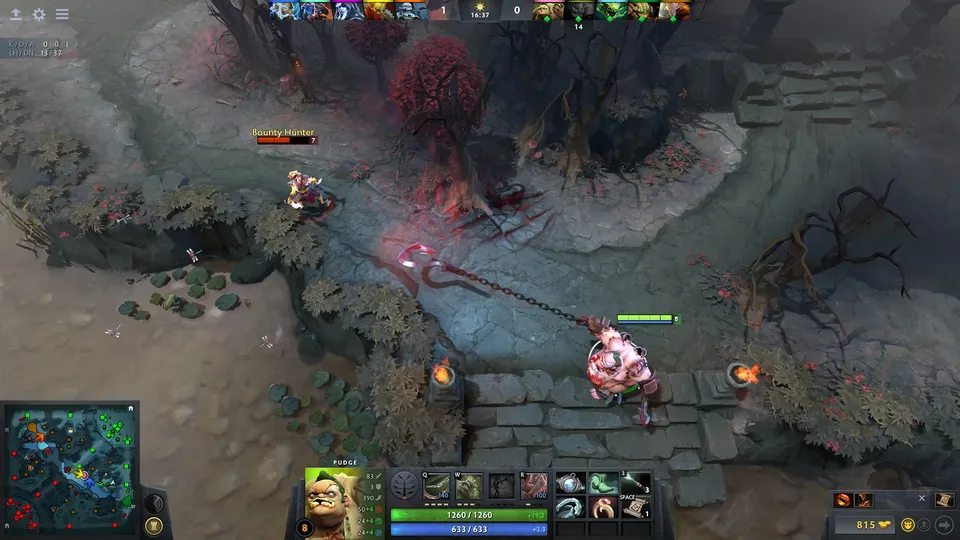
Dota 2 is complexity as a product, and it makes no apologies for it. Denying creeps, turn rates, day/night vision cycles, tree juking, buyback economics, Aghanim’s upgrades, neutral item RNG — every one of these systems exists because it creates decision points that separate skill levels. Where League simplifies to broaden its audience, Dota doubles down on depth to reward the players who stay.
The item system alone puts it above almost everything else on this list. In League, you follow a build guide. In Dota, itemization is a living puzzle that changes based on the draft, the game state, and what the enemy is building. A Black King Bar game plays completely differently from a Linken’s Sphere game. The strategic variance is enormous because the systems are deep enough to support genuinely different game plans every match.
The honest criticism: the learning curve isn’t a curve, it’s a wall. The International prize pools peaked and the esports scene has contracted. Valve’s near-silence frustrates a community that wants to know what’s coming next. And the new player funnel has never been good; Dota survives on retention, not acquisition.
Who it’s for: Players who want the most mechanically dense MOBA in existence. Players who find League too streamlined. Players who genuinely enjoy agonizing over item builds for thirty seconds while their team pings them.
3. Deadlock
Developer: Valve | Platform: PC | Price: Free-to-play | Status: Live (launched from beta late 2025)
Deadlock is the most interesting PVP game in years, and its placement at #3 reflects the fact that it’s doing something genuinely new rather than iterating on what exists. It’s a third-person shooter with full MOBA mechanics — lanes, creeps, towers, items, objectives — and the fact that it works at all is a testament to Valve’s design team.
What makes Deadlock special is that neither the shooter half nor the MOBA half feels compromised. The gunplay is satisfying. The laning has real depth. The item system creates build diversity that hero shooters can’t replicate. And the movement mechanics — ziplines, dashes, verticality — give it a kinetic energy that traditional MOBAs lack entirely.
The honest criticism: it’s still finding its identity. The hero roster is growing but not yet deep enough for Dota-level draft complexity. Balance is volatile — expect your main to get reworked. Visual clarity in teamfights can be a mess. And matches run 30-40 minutes, which is a lot to ask from a shooter audience.
Who it’s for: MOBA veterans who want something that feels genuinely new. Shooter players curious about strategic depth. Anyone who played Dota and thought “this would be incredible if I could aim.”
Tier 2: The Strong Contenders
4. Smite 2
Developer: Hi-Rez Studios | Platform: PC, Console | Price: Free-to-play | Status: Live (launched 2025)
Smite 2 takes the MOBA formula and makes you aim everything. The Unreal Engine 5 rebuild is gorgeous. The god kits have been modernized without losing their identity. And the third-person camera creates a form of information asymmetry that isometric MOBAs simply can’t replicate — you can’t see behind you, which means flanking and jungle ganks carry genuine tension.
Smite has always occupied a unique space: it’s the MOBA for people who want MOBA strategy but with action game execution. The relic system creates cooldown trading that’s more accessible than League’s summoner spell tracking but still deep. The role system is familiar. The mythology theme gives it a character identity that stands apart from the fantasy-sci-fi blend of its competitors.
The honest criticism: the Smite 1 to Smite 2 transition fractured the community. Progression reset angered veterans. Some god kits feel worse than their Smite 1 versions. Matchmaking quality is inconsistent, especially at off-peak hours, and the ranked population hasn’t fully recovered from the transition turbulence. Hi-Rez’s track record of supporting games long-term is a legitimate concern for anyone thinking about investing serious time.
Who it’s for: Players who want MOBA depth with action game controls. Console MOBA players who don’t have many options. Anyone who found top-down MOBAs too detached and wants to feel closer to the action.
5. Honor of Kings
Developer: TiMi Studio Group (Tencent) | Platform: Mobile, PC | Price: Free-to-play | Status: Live, 100M+ daily active users
This is the biggest game in the world by revenue and daily active users, and most Western MOBA players have never touched it. Honor of Kings dominates the Chinese mobile market so completely that it’s less a game and more a cultural institution. The gameplay is clean, well-balanced 5v5 MOBA combat designed for touchscreen controls and ten-minute match times.
What Honor of Kings gets right is pacing. Matches are fast without feeling shallow. Hero kits are readable, satisfying to execute, and balanced around mobile input without dumbing down the strategic layer. The esports scene in China is massive, rivaling League’s LPL in production and viewership.
The honest criticism: the Western version has struggled against Wild Rift and Mobile Legends. The cultural moat works both ways — the game is built for a Chinese audience, and some hero design and monetization choices feel unfamiliar to Western players. The PC port feels like what it is: a mobile game on a bigger screen.
Who it’s for: Mobile MOBA players looking for the most polished competitive experience on the platform. Anyone curious about what the biggest game in the world actually plays like. Players who want fast, clean MOBA matches without the 35-minute commitment.
6. Pokemon Unite
Developer: TiMi Studio Group | Platform: Mobile, Switch | Price: Free-to-play | Status: Live
Pokemon Unite has no business being as good as it is. A Pokemon MOBA for mobile and Switch sounds like a cynical cash grab — and the monetization absolutely is one. But underneath the predatory item enhancement system is a genuinely well-designed competitive game that understands something most MOBAs don’t: objective timing is more interesting than laning.
The Zapdos mechanic — a late-game objective that can swing an entire match in seconds — creates tension that traditional MOBAs only achieve in rare comeback scenarios. Every match builds to a decisive moment. The ten-minute limit means constant pressure. And the Pokemon have kits that are simple to learn but have real skill ceilings.
The honest criticism: the item system is still pay-to-win adjacent. The game communicates its mechanics poorly — many players don’t understand scoring zones or experience scaling for dozens of hours. Balance patches are infrequent. Ranked matchmaking can make climbing feel arbitrary.
Who it’s for: MOBA-curious players who want something approachable. Pokemon fans. Parents who want to play with their kids. Competitive players who appreciate tight time limits and objective-focused gameplay over laning.
7. Mobile Legends: Bang Bang
Developer: Moonton | Platform: Mobile | Price: Free-to-play | Status: Live, massive SEA playerbase
Mobile Legends is the dominant MOBA in Southeast Asia, and its competitive scene there rivals League’s in viewership and cultural penetration. The gameplay is straightforward 5v5 MOBA combat optimized for mobile — fast matches, aggressive early-game pacing, and a hero roster that favors flashy plays.
What it does well is accessibility without sacrificing competitive depth. Controls are responsive. Matchmaking is fast. The hero release cadence keeps the meta fresh. And the ranked system does a reasonable job of stratifying skill levels in a massive playerbase.
The honest criticism: it’s a League of Legends clone. The early heroes were so transparently copied from League champions that Riot sued — and won. The game has since developed its own identity, but the DNA is obvious. Balance is messier than the top-tier MOBAs, and if you’re on PC, there’s no reason to play this over League or Dota.
Who it’s for: Mobile-first players in regions where Mobile Legends is the dominant competitive game. Players who want fast, aggressive MOBA matches on their phone. Anyone in Southeast Asia who wants the largest possible ranked pool.
8. Wild Rift
Developer: Riot Games | Platform: Mobile, Console | Price: Free-to-play | Status: Live
Wild Rift is not League of Legends on mobile. It’s a different game that shares League’s champions and visual identity but has its own balance, item system, and meta. Maps are smaller, matches are shorter (15-20 minutes), and controls are redesigned for touchscreen and gamepad.
What impresses me is the quality. It feels like a Riot game. Champion kits have been thoughtfully adapted — abilities that rely on precise cursor placement in League are reworked with mobile targeting in mind. Visual fidelity is excellent for mobile. The ranked system is cleaner than League’s desktop client in some ways.
The honest criticism: it lives in League’s shadow. The champion roster is significantly smaller. Esports investment has been inconsistent — Riot has struggled to build a Wild Rift competitive scene that doesn’t feel second-class. And the Western playerbase is smaller than you’d expect, partly because MOBA players who own PCs just play League.
Who it’s for: League players who want to play on mobile or console. Console players who want a polished MOBA. Mobile gamers who want the Riot polish that Mobile Legends lacks.
9. Heroes of the Storm
Developer: Blizzard Entertainment | Platform: PC | Price: Free-to-play | Status: Maintenance mode (no new content, servers live)
Heroes of the Storm is the best MOBA that Blizzard killed. It removed individual experience and gold, replacing them with shared team levels and talent trees. It replaced a single map with objective-focused battlegrounds. It removed last-hitting entirely. These created a MOBA where team coordination mattered more than individual farm, and every match played differently because map objectives demanded different strategies.
The talent system was genuinely innovative. Instead of items, you chose talents at fixed level thresholds that modified your abilities. A Kael’thas who took Living Bomb spread played a completely different game than one who took mana sustain. Locked in for the match, creating commitment that changeable item builds don’t.
The honest criticism: Blizzard pulled the plug on competitive support in 2018 and moved the dev team to other projects. There has been no new hero or meaningful balance patch in years. The ranked queue times are long and getting longer. The game is in hospice. Playing Heroes of the Storm in 2026 means loving a ghost and accepting that the community is slowly shrinking toward zero.
Who it’s for: MOBA players who hate last-hitting. Team-first players who want coordination to matter more than individual carry potential. Blizzard fans who want one last ride with their favorite IP crossover. Anyone willing to fall in love with a dead game.
10. Battlerite
Developer: Stunlock Studios | Platform: PC | Price: Free-to-play | Status: Servers live, effectively dead (~100 concurrent)
I’ve written extensively about why Battlerite failed, and the short version is: the gameplay was exceptional but everything around it — onboarding, monetization, content cadence, and that catastrophic battle royale pivot — failed to sustain the playerbase. Battlerite’s combat remains the best moment-to-moment PVP any team game has ever produced, and I will keep saying that until someone proves me wrong.
Every ability is a skillshot. The counter system creates fighting game mind games in a team setting. The round structure eliminates snowballing. The energy/EX system rewards cooldown trading and resource management. It’s pure PVP stripped to its bones — no lanes, no creeps, no items, no thirty-minute commitment. Just you, your team, your abilities, and the skill to use them.
The honest criticism: it’s dead. You can technically still play it, but queue times are measured in minutes and the players who remain are veterans who will dismantle newcomers. Stunlock moved on. The battle royale mode was a waste of resources that accelerated the decline. And the core problem — that arena brawlers are brutally hard to onboard new players into — was never solved.
Who it’s for: PVP purists who value mechanical combat above all else. Fighting game players who want a team setting. Anyone willing to accept brutal queue times for the best combat in the genre. And anyone building the next arena brawler who needs to study what Battlerite got right and wrong.
Tier 3: The Niche Picks
11. Predecessor
Developer: Omeda Studios | Platform: PC, Console | Price: Free-to-play | Status: Live (early access/launched 2024-2025)
Predecessor carries the torch for Paragon, Epic’s third-person MOBA shuttered in 2018 for Fortnite. Built on Unreal Engine 5 using Paragon’s open-sourced hero assets, it’s the most faithful recreation of what Paragon was trying to be — a third-person MOBA with verticality, action combat, and visual spectacle.
The hero roster has been expanding steadily. Jungle and map design create genuine three-dimensional thinking — elevation matters, and fights play out differently on high ground versus low ground in ways flat MOBAs can’t replicate.
The honest criticism: the playerbase is small and matchmaking suffers for it. It’s competing with Smite 2 and Deadlock for the “action MOBA” audience without Smite’s brand recognition or Deadlock’s Valve backing. Paragon nostalgia isn’t enough to sustain long-term growth on its own.
Who it’s for: Paragon veterans who miss the game. Third-person action fans who want a MOBA that feels like a shooter. Players who want Smite’s perspective but with a darker, more grounded aesthetic.
12. Arena of Valor
Developer: TiMi Studio Group (Tencent) | Platform: Mobile | Price: Free-to-play | Status: Live, significant Asian playerbase
Arena of Valor is Honor of Kings’ international twin — same engine, same studio, different heroes and balance tuned for non-Chinese markets. It was Tencent’s bid to dominate mobile MOBAs globally. That bid failed in the West but succeeded in parts of Asia.
The gameplay is polished mobile MOBA combat. Matches are fast. Controls are responsive. What Arena of Valor lacks is identity — it doesn’t do anything that Honor of Kings, Wild Rift, or Mobile Legends don’t also do.
The honest criticism: it’s the “other” Tencent mobile MOBA. Western support has been inconsistent. Esports investment outside of Asia has dried up. The hero roster, while competent, doesn’t have the standout design that makes League champions or Mobile Legends heroes memorable.
Who it’s for: Mobile MOBA players in markets where Arena of Valor has an active community. Players who want Honor of Kings’ quality but with a more internationally accessible wrapper.
13. Supervive
Developer: Theorycraft Games | Platform: PC | Price: Free-to-play | Status: Live (launched 2025)
Supervive is the most ambitious attempt to merge battle royale with MOBA mechanics since Battlerite Royale, and it’s doing it significantly better. You pick a hero with MOBA-style abilities, drop into a large map, fight other teams, and the zone shrinks. The twist is that ability kits have genuine depth — cooldown management, combo potential, and team composition all matter.
The movement system is the standout. Every hero can glide, and the air-to-ground transitions create verticality that keeps fights dynamic. Team composition matters — bringing a support means your team sustains through attrition; bringing three damage dealers means you’re gambling on fast kills.
The honest criticism: queue times can be rough off-peak. The BR format means downtime between fights, which MOBA purists find tedious. Hero balance is volatile. And the fundamental tension between BR randomness and MOBA skill expression hasn’t been fully resolved.
Who it’s for: BR players who want more mechanical depth. MOBA players who want faster matches with elimination stakes. Anyone who liked the idea of Battlerite Royale but wanted it executed competently.
14. Eternal Return
Developer: Nimble Neuron | Platform: PC | Price: Free-to-play | Status: Live, niche but stable
Eternal Return is the other BR/MOBA hybrid, taking a completely different approach from Supervive. The island setting, crafting system, and survival elements give it more in common with a survival game than a traditional MOBA. You scavenge materials, craft items from recipes, and fight other players in a shrinking zone — but your character has a full MOBA ability kit.
The crafting system is what sets it apart. You plan a crafting route through the map, gathering components for your build. Route optimization becomes a skill — experienced players know exactly which zones to visit to hit item power spikes fastest. It’s strategic planning that neither pure MOBAs nor pure BRs offer.
The honest criticism: overwhelming for newcomers. The playerbase is small in Western markets, centered in Korea. The anime aesthetic will attract or repel players immediately. Balance swings can be dramatic on character launch.
Who it’s for: Players who enjoy crafting and route optimization. Anime fans who want competitive PVP. Korean gaming enthusiasts. Anyone who wants a BR that rewards planning as much as mechanical skill.
15. Omega Strikers
Developer: Odyssey Interactive | Platform: PC, Mobile, Console | Price: Free-to-play | Status: Live, small playerbase
Omega Strikers proves MOBA mechanics can work in unexpected contexts. It’s air hockey meets MOBA — three players per team use hero abilities to knock a ball into the opponent’s goal. The hero kits have cooldowns and combos that feel distinctly MOBA-derived, but the goal-scoring format makes it instantly understandable.
Character design is sharp. Abilities interact with the ball and opponents in creative ways. Matches are fast, usually under ten minutes. The scoring format creates natural drama.
The honest criticism: the playerbase has shrunk significantly. The competitive scene never materialized. MOBA elements are lite enough that hardcore players find it shallow, while casuals have dozens of other options.
Who it’s for: Players who want MOBA-style hero abilities in a sports game context. Groups looking for a casual-friendly team game. Anyone who wants fast matches with a low commitment threshold.
16. Fault
Developer: Strange Matter Studios | Platform: PC | Price: Early Access | Status: In development, small community
Fault is the other Paragon successor, and it occupies a difficult position. Like Predecessor, it uses Epic’s open-sourced Paragon assets. Unlike Predecessor, it hasn’t achieved critical mass.
It leans harder into traditional MOBA itemization — more of a classic MOBA in third person than a shooter with MOBA elements. The design differentiation from Predecessor is deliberate and defensible.
The honest criticism: the playerbase is tiny. Development has been slow. There’s only room for one Paragon successor, and Fault is losing that race.
Who it’s for: Die-hard Paragon fans who want to support an alternative vision. Players who prefer Fault’s specific design choices over Predecessor’s. Developers studying how two games can share an asset base and diverge.
Tier 4: The Genre’s Memory
17. Gigantic
Developer: Motiga / Gearbox | Platform: PC, Xbox | Price: Free-to-play | Status: Dead (briefly revived 2024, re-shut down)
Gigantic was a hero shooter/MOBA hybrid that launched in 2017, died in 2018, was briefly resurrected in 2024, and died again. It’s here because its design was genuinely innovative and its failure illustrates the genre’s recurring tragedy: great gameplay can’t save a game that can’t find an audience.
The core hook was the guardian system — each team had a massive creature, and map control empowered your guardian to attack the enemy’s, creating damage windows. The art direction was stunning, the movement felt incredible, and the hero kits had meaningful upgrade choices.
The honest criticism: it died twice. Publisher mismanagement killed it the first time. Insufficient playerbase killed the revival. Gigantic deserved better. The market disagreed.
Who it’s for: Nobody, anymore. But if you’re designing a MOBA or hero shooter hybrid, study Gigantic’s guardian system and movement design. There are ideas there worth stealing.
18. Vainglory
Developer: Super Evil Megacorp | Platform: Mobile | Price: Free-to-play | Status: Dead (community servers)
Vainglory was the first mobile MOBA that felt like a real competitive game. Before Wild Rift, before Mobile Legends dominated Southeast Asia, Vainglory proved that touchscreen controls could support genuine MOBA depth. The 3v3 Halcyon Fold map was tight. The hero kits had real complexity. The touch controls were precise enough for competitive play.
Super Evil Megacorp wanted Vainglory to be the mobile esport, and for a brief window, it was. Tournament support, a dedicated competitive scene, a playerbase that cared deeply about skill expression.
The honest criticism: it died because the mobile market moved faster than the developers could adapt. The expansion to 5v5 stretched the design beyond what it could handle. Monetization never generated enough revenue. When Honor of Kings, Mobile Legends, and Wild Rift entered with larger budgets, Vainglory couldn’t compete. Community-run servers keep a fragment alive for the faithful.
Who it’s for: Mobile gaming historians. Designers studying how to build competitive games for touchscreen. Anyone who wants to understand the mobile MOBA wars that shaped the current landscape.
19. Heroes of Newerth
Developer: S2 Games / Frostburn Studios | Platform: PC | Price: Free-to-play | Status: Dead (servers shut down 2022)
Heroes of Newerth was the original Dota successor, and from 2010 to 2013, it was the most mechanically demanding MOBA in existence. HoN ported Dota mechanics to a proprietary engine with better netcode, faster responsiveness, and visual clarity that made teamfights more readable than Dota’s Warcraft III mod roots allowed.
The original hero designs — Deadwood, Puppet Master, Electrician — had kits that felt distinct and satisfying. The competitive scene produced genuinely skilled players, many of whom transitioned to Dota 2 and found success.
The honest criticism: S2 Games made catastrophic business decisions. Charging for beta fractured the playerbase. The free-to-play shift came with pay-to-win early access heroes that destroyed competitive trust. And when Dota 2 launched, HoN’s entire reason to exist — “Dota but better” — evaporated. The servers shut down in 2022.
Who it’s for: Dota historians. Anyone who wants to understand the pre-Dota 2 era of the MOBA genre. Developers studying how first-mover advantage can be squandered through poor business decisions.
20. Bloodline Champions / Battlerite (Arena MOBA Pioneers)
Developer: Stunlock Studios | Platform: PC | Price: Free-to-play (Battlerite) / Dead (BLC) | Status: BLC dead, Battlerite on life support
I’m combining these because they’re the same lineage and the same lesson. Bloodline Champions launched in 2011 and invented the arena brawler — a MOBA stripped to pure combat. No lanes, no creeps, no items, no leveling. Just 3v3 skillshot combat with counter-based defensive mechanics that gave the genre a fighting game depth nothing else has replicated.
BLC died because of poor monetization, a tiny studio, and a market that wasn’t ready for arena PVP as a standalone genre. Battlerite was Stunlock’s second attempt with better visuals, modernized design, and a larger marketing push. The combat was even better. The result was the same: phenomenal gameplay, inadequate everything else.
What these games pioneered matters more than their commercial failure. The all-skillshot design philosophy. The counter/parry system. The EX ability resource management. The round-based format that eliminates snowballing. Every arena brawler since — and the arena PVP elements showing up in games like Deadlock and Supervive — traces its design DNA back to what Stunlock built first in a small Swedish studio.
Who it’s for: PVP historians. Game designers. Anyone who believes that the best gameplay doesn’t always win, and wants to understand why. And anyone building the next arena brawler who needs to study these games like scripture — because the genre’s future depends on someone solving the problems that Stunlock couldn’t.
What This List Tells Us About the Genre
Three patterns emerge from ranking these twenty games:
The top is calcified. League and Dota have been #1 and #2 for over a decade. Deadlock cracked the top three by being a fundamentally different kind of game rather than competing on League and Dota’s terms. If you’re making a traditional lane-pushing MOBA in 2026, you’re fighting for third place at best.
Mobile is where the growth is. Four of the top twelve games are mobile-first. Honor of Kings has more daily active users than League and Dota combined. The Western MOBA conversation focuses on PC, but globally, more people play MOBAs on their phones than on any other platform. The future of the genre, by raw numbers, is touchscreen.
Hybrids are the frontier. Deadlock, Supervive, Eternal Return, Omega Strikers — the most interesting new entries merge MOBA mechanics with other genres. The pure lane-pushing MOBA is a solved design problem. The unsolved problems — combining MOBA depth with shooter execution, BR stakes, or sports game accessibility — are where the innovation is happening.
And then there’s the graveyard. Vainglory, Heroes of Newerth, Gigantic, and arguably Heroes of the Storm each proved that great gameplay alone isn’t enough. You need infrastructure, onboarding, content, and marketing — or you need to be so different that you’re not really competing at all.
The MOBA genre isn’t dying. It’s specializing. The giants own the center. The future belongs to the edges.

Discussion