
This is the list I’ve wanted to write since I started this site.
Arena brawlers are IFLPVP’s home genre. Bloodline Champions is the game that made me care about competitive PVP. Battlerite is the game that proved the formula could work at scale — briefly — before everything fell apart. The years since have been a slow mourning process, watching a genre that delivered the best moment-to-moment PVP combat I’ve ever experienced slowly fade from the conversation.
But here’s the thing: the genre isn’t dead. It’s scattered. The DNA of arena brawlers — small teams, ability-based kits, compact arenas, skill-expression in every button press — lives on in platform fighters, mobile brawlers, hero shooters, and a handful of indie projects trying to bring the original formula back.
This list is broad on purpose. Pure arena brawlers are a tiny genre. If I only ranked games that fit the strict BLC/Battlerite mold, this would be a list of five entries, three of which are dead. So I’ve included adjacent games — platform fighters, arena shooters, ability-based combat games — anything where you load into a compact space and fight other players using a kit of unique abilities.
The ranking considers competitive depth, how well the game captures the arena brawler spirit, community health in 2026, and how much it rewards mastery. Legacy matters too. Some of these games are dead. They still deserve recognition for what they built.
If you’re new to the genre, start with our beginner’s guide to arena brawlers — it covers cooldown trading, orb control, and the fundamentals that make this style of PVP so rewarding.
The Standard-Bearers
1. Battlerite
Genre: Arena Brawler | Team Size: 2v2, 3v3 | Status: Servers running, no development | Price: Free-to-play
Number one is not a living game. I know that’s unusual for a ranked list, but there’s no honest way to rank arena brawlers without putting Battlerite at the top. The game is the genre’s gold standard, and nothing released since has matched its combat.
Every ability was a skillshot. Every heal, every shield, every escape — aimed manually. The counter system created mind games that gave the combat a fighting game depth: do you attack into the counter, bait it out, or hold your cooldown and wait? The cooldown trading was deeper than in any other team PVP game because every ability was both an offensive tool and a resource you were spending. Using your escape aggressively meant you had no escape for the next 10 seconds. That trade-off was the entire game.
The round structure kept things tight. Best of five, two-minute rounds, sudden death to force a conclusion. No snowballing. No 30-minute time commitments. Every round was a clean reset where only skill carried over. The center orb created a focal point for fights, a reason to engage rather than run.
I’ve written extensively about why Battlerite failed — the battle royale pivot, the new player cliff, the monetization confusion. None of it was about the combat. The combat was the best PVP I’ve ever played, and I mean that without exaggeration. If you can still find matches (queue times are long, but not impossible during peak hours), do yourself a favor.
Why it’s here: It set the bar. Everything else on this list is measured against it. For a complete breakdown of what made its roster special, see our champion guide.
2. Bloodline Champions
Genre: Arena Brawler | Team Size: 2v2, 3v3, 5v5 | Status: Offline (servers shut down) | Price: Was free-to-play
If Battlerite refined the formula, Bloodline Champions invented it. Stunlock Studios’ 2011 game took MOBA-style abilities, stripped away everything that wasn’t direct PVP combat, and created something that felt genuinely new. No auto-attacks. No items. No creeps. No lanes. Just abilities, cooldowns, and the other team.
BLC was harder than Battlerite. The pacing was more punishing, the visual clarity was rougher, and the learning curve was steeper. But for the players who got through that curve, the game delivered a competitive depth that rewired your brain. You stopped thinking in terms of “use ability on enemy” and started thinking in terms of cooldown windows, positional advantage, and ability trading sequences. The moment you realized you were tracking every cooldown on every enemy unconsciously was the moment the genre hooked you permanently.
The game never achieved commercial success. The audience was too niche and the genre didn’t have a name yet. But BLC proved the concept, and every arena brawler that followed owes its existence to what Stunlock built here.
Why it’s here: The pioneer. Without BLC, this genre doesn’t exist. The gameplay holds up remarkably well in memory and concept, even if you can’t play it anymore.
3. Super Smash Bros. Ultimate
Genre: Platform Fighter | Team Size: 1v1 to 4-player FFA | Status: Active (no updates) | Price: $60
This might seem like an odd pick for an arena brawler list, but Smash Ultimate captures the core appeal better than most games that carry the label. Compact stages. Unique character kits with deep ability interactions. Matches decided in minutes. Skill expression in every input. The arena is just rotated 90 degrees.
Ultimate’s roster of 89 characters is absurd, and somehow most of them work. The competitive scene, focused on 1v1 with items off, is one of the deepest in all of gaming. Movement tech, spacing, edge-guarding, advantage state — the skill ceiling is practically vertical. Top players demonstrate a level of read-based prediction and adaptation that rivals anything in traditional fighters.
The lack of rollback netcode is the elephant in the room. Online Smash is functionally a different, worse game than offline Smash, and Nintendo’s continued indifference to competitive infrastructure is maddening. But at locals and tournaments, nothing in the platform fighter space matches it.
Who it’s for: If you want the deepest platform fighter with the largest competitive scene and don’t mind that online play is subpar. If you have a local scene, this is the best competitive experience in the subgenre.
4. Rivals of Aether II
Genre: Platform Fighter | Team Size: 1v1 to 4-player | Status: Active, receiving updates | Price: $30
Rivals 2 is what happens when a competitive community builds the game it wants. Dan Fornace and the team at Aether Studios took everything the platform fighter community asked for — rollback netcode, deep movement, viable characters at every archetype — and delivered it in a package that respects competitive players by default rather than as an afterthought.
The elemental system gives each character a unique resource mechanic. Fire characters build heat for powered-up attacks. Earth characters set traps. Air characters have enhanced aerial mobility. Every matchup has a different texture, and learning a new character means learning a fundamentally different resource game.
Workshop integration from Rivals 1 is returning — community-created characters with the same depth as the base roster. That’s the kind of pipeline that extends a competitive game’s lifespan indefinitely.
Who it’s for: Platform fighter players who want competitive-first design with excellent netcode. If you love Melee’s speed but want modern infrastructure, Rivals 2 is your game.
5. Brawl Stars
Genre: Mobile Arena Brawler | Team Size: 3v3, various modes | Status: Active, major updates | Price: Free-to-play
Brawl Stars is probably the most successful arena brawler ever made, and the fact that it’s on mobile doesn’t diminish that. Supercell took the core pillars — small teams, compact arenas, unique character kits — and translated them to touch controls with shocking fidelity. The dual-joystick scheme works. The matches are fast. The brawler roster has genuine depth.
The variety of game modes — Gem Grab, Brawl Ball, Bounty, Showdown — keeps the format from getting stale, and each mode rewards different team compositions and strategies. The competitive scene is real, with monthly finals and a world championship circuit that draws serious players.
The monetization is aggressive in the way mobile games tend to be. But the core PVP — the actual combat, the ability interactions, the team coordination — is legitimate. Brawl Stars proved the arena brawler formula can work at massive scale if you meet players where they are.
Who it’s for: Anyone who wants arena PVP they can play in three-minute sessions. If you’ve dismissed it because it’s mobile, give it an honest try. The skill ceiling is higher than you think.

The Contenders
6. Brawlhalla
Genre: Platform Fighter | Team Size: 1v1, 2v2 | Status: Active, receiving updates | Price: Free-to-play
Brawlhalla is the gateway drug of platform fighters. Free-to-play with a rotating character roster, crossplay across every platform, and a matchmaking system that actually works — it removes every barrier to entry that the genre typically puts up. Queue into a match in 30 seconds, fight for two minutes, do it again. The friction is nearly zero.
The weapon system is the defining mechanic. Characters are defined by which two weapon types they can pick up — sword and spear plays differently from sword and lance, even though the sword moveset is identical. This creates strategic depth around weapon spawns and adaptation that other platform fighters don’t have.
The competitive scene is surprisingly deep. Brawlhalla Championship Series tournaments regularly draw viewers, and the top players demonstrate that the simplified aesthetic hides real mechanical depth.
Who it’s for: New platform fighter players, anyone who wants competitive PVP with zero upfront cost, and people who want to play cross-platform with friends. The entry point for the entire subgenre.
7. Omega Strikers
Genre: Arena Brawler / Sports Hybrid | Team Size: 3v3 | Status: Active, scaled back updates | Price: Free-to-play
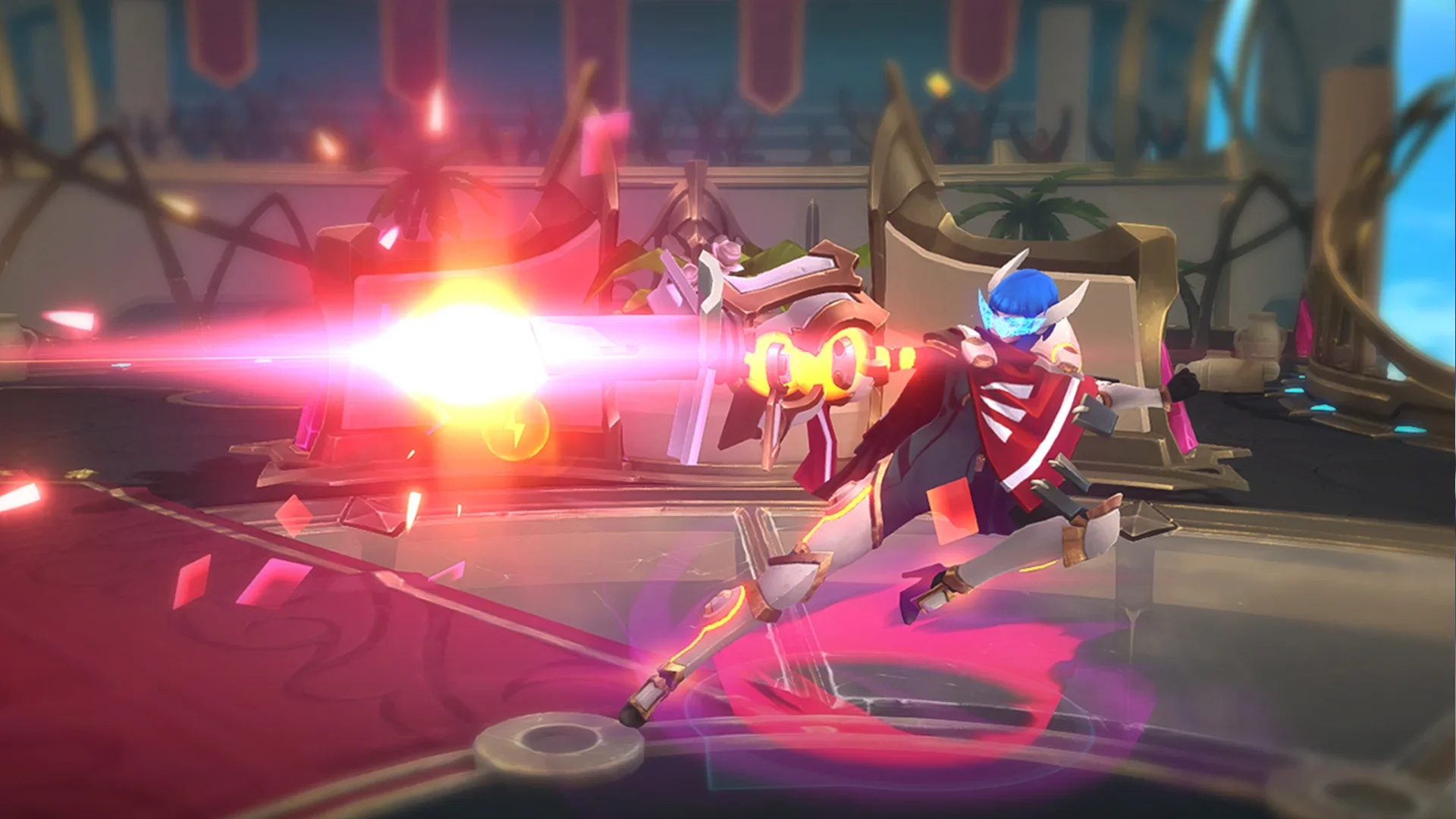
Omega Strikers asked an interesting question: what if Battlerite was a sport? Three players per side, a puck-like core to knock into the enemy goal, and a roster of characters with unique ability kits that affect both the “ball” and other players. The result is something that feels genuinely novel — not quite a MOBA, not quite an arena brawler, not quite a sports game, but a hybrid that borrows the best parts of each.
The goalie role is the standout design choice. One player guards the goal while two play forward, creating natural role specialization without forcing it. The forward/goalie dynamic adds a team coordination layer that pure deathmatch arena games don’t have.
Player count has tapered as the content pipeline slowed — the familiar story for niche PVP games. But the core loop is creative, well-executed, and still playable with reasonable queue times.
Who it’s for: Players who want arena brawler mechanics in a less stressful context. The sports objective gives you something to focus on beyond pure combat, which makes losses feel less personal and the learning curve less punishing.
8. Naraka: Bladepoint
Genre: Melee Battle Royale / Arena-Adjacent | Team Size: Solo, Duos, Trios | Status: Active, receiving updates | Price: Free-to-play
Naraka isn’t an arena brawler by any traditional definition, but the combat system is so clearly descended from the same design philosophy that it earns a spot. The melee focus — with parries, counters, combo strings, and directional attacks — creates the kind of read-based PVP that arena brawler players crave. Every fight is a micro-arena encounter within the larger battle royale structure.
The grappling hook mobility transforms the map into a vertical playground where positioning matters as much as combat. The wuxia-inspired aesthetic gives it a visual identity that stands alone in PVP.
The battle royale format dilutes the combat density that arena brawlers deliver. But when you find a fight in Naraka, the exchange is closer to Battlerite than it is to Fortnite.
Who it’s for: Players who want arena brawler-style combat depth in a larger-scale game. If you love the read-based fighting but want more variety in your match structure, Naraka delivers.
9. MultiVersus
Genre: Platform Fighter | Team Size: 1v1, 2v2 | Status: Active, receiving updates | Price: Free-to-play
MultiVersus had a rough road — strong open beta, full shutdown, rocky re-launch. But the 2v2-focused design makes it unique. Most platform fighters are designed for 1v1 first; MultiVersus was built for teams. Perks that buff your teammate, abilities that set up partner combos, classes that define your role in a duo — the team-based design is genuine, not cosmetic.
The Warner Bros. IP works better than it should. Batman fighting Shaggy fighting Arya Stark shouldn’t feel cohesive, but consistent mechanical design under the aesthetic variety holds it together. The re-launch lost community trust and the monetization is aggressive, but the core 2v2 gameplay delivers something no other platform fighter does.
Who it’s for: Players who want team-based platform fighting. If you always preferred doubles in Smash, MultiVersus was designed for you.
10. Gigantic
Genre: Arena Hero Brawler | Team Size: 5v5 | Status: Briefly revived 2024, now offline again | Price: Was free-to-play
Gigantic is the game that haunts this genre. A third-person hero brawler where two teams of five fought to power up their team’s guardian — a massive creature that would then assault the enemy’s guardian. The heroes had deep, ability-rich kits. The map design funneled teams into skirmishes around control points. The art style was gorgeous, a painterly aesthetic that still looks better than most games releasing today.
Motiga ran out of funding. The game shut down in 2018. In 2024, Gearbox briefly revived it as Gigantic: Rampage Edition — a gift to the community, but not a resurrection. The servers went offline again.
What Gigantic got right was the macro objective layer. The guardian system gave fights meaning beyond “kill the other team.” Every skirmish over a control point contributed to your guardian’s power, and when the guardian rampaged, the entire game shifted into attack-or-defend. That rhythm was addictive.
Why it’s here: One of the most creative takes on arena-scale hero combat ever made. Dead, but the design ideas deserve to be remembered and stolen.
The New Wave
11. Nebulagon
Genre: Arena Brawler | Team Size: 2v2, 3v3 | Status: In development | Price: TBD
Full disclosure: Nebulagon is being built by this site’s founder. I’m including it because it’s directly relevant to the genre, not because I’m shilling. It’s early in development and completely unproven — no public build, no player feedback, no competitive scene. But the BLC/Battlerite DNA is real, and it belongs in a conversation about the genre’s future.
Nebulagon is a 2D top-down arena brawler with 8 heroes, each carrying a full 9-ability kit: M1, M2, Q, R, F, E, Space, EX1, and EX2. The combat system is built around cooldown trading, skillshot aiming, and energy management. The 2D approach is a deliberate choice — lower art production overhead means faster gameplay iteration, which is where arena brawlers succeed or fail.
The honest assessment: it’s one developer trying to rebuild a genre that AAA studios couldn’t sustain. The odds are not great. But someone needs to keep making these games, and the worst outcome is another entry in the arena brawler graveyard that at least tried.
Why it’s here: Because this is a list about the genre, and the genre needs new games. For development updates, see the first devlog.
12. Alea
Genre: Arena Brawler | Team Size: 1v1, 2v2, 3v3 | Status: Demo available, full release expected 2026 | Price: TBD
Alea is the most direct Battlerite successor currently in active development, and the early signs are promising. Built by a team that clearly understands what made the genre work, Alea features a dual-skillset system where every hero has two ability loadouts you can switch between mid-match. The mind game of which loadout you’re running adds prediction depth without increasing button complexity.
The demo, shown during Steam’s PVP Fest, drew cautious optimism from the Battlerite diaspora. Movement feels responsive. Abilities read clearly. The combat pacing hits the sweet spot between the tactical deliberation of BLC and the faster action of Battlerite. These are the fundamentals that matter, and Alea appears to have them.
The existential question is the one that hangs over every game in this genre: can it sustain a player base? The dual-skillset system adds replayability, which helps retention. But no design innovation solves the cold start problem of needing enough concurrent players for healthy matchmaking.
Who it’s for: Battlerite refugees. If you’ve been waiting for someone to make another real arena brawler, Alea is the most likely candidate to deliver.
13. Spellbreak
Genre: Magic Arena / Battle Royale Hybrid | Team Size: Solo, Duos, Trios | Status: Shut down (2023) | Price: Was free-to-play
Spellbreak was beautiful and doomed. A magic-combat battle royale where you combined elemental gauntlets — fire and wind to create fire tornadoes, ice and poison to create toxic frozen zones — with free-form spellcasting in a fantasy landscape. The combat felt like nothing else. Hovering above a battlefield, raining lightning and fire while weaving between enemy spells, had a kinetic energy that no other game matched.
The element combination system was the game’s genius. Mastering the interactions between six elements created a skill ceiling far beyond aim — knowing which combinations to use, how to counter enemy pairings, and how to control space with persistent effects. This was arena brawler depth in a battle royale shell.
Proletariat couldn’t solve the population problem. The game went through multiple format pivots before shutting down entirely, the studio acquired by Blizzard. The combat deserved a better fate.
Why it’s here: The most creative ability-based combat system in any arena-scale PVP game. Dead, but the element combination design is a blueprint someone should build on.
14. Knockout City
Genre: Dodgeball Arena | Team Size: 3v3, 4v4 | Status: Shut down (2023), community servers available | Price: Was free-to-play
Knockout City took the simplest possible combat premise — dodgeball — and built a legitimate competitive game around it. Catching, throwing, faking, curving, lobbing, passing to teammates, turning yourself into a ball — the mechanical depth Velan Studios extracted from “throw ball at person” was remarkable.
The team play was where it shone. Passing to teammates in better position, coordinating double-catches, setting up charged throws from teammate passes — the cooperative mechanics rewarded coordination over pure mechanical skill. For a game that looked casual, the competitive ceiling was genuinely high.
EA pulled the plug on official servers, but the community has maintained private servers. The player base is tiny, but passionate about what this game did differently.
Why it’s here: Proof that arena PVP doesn’t need to be about damage numbers and health bars. The mechanical creativity deserves recognition.

15. Rocket Arena
Genre: Ability-Based Arena Shooter | Team Size: 3v3 | Status: Shut down (2022) | Price: Was $30, then free-to-play
Rocket Arena was a 3v3 arena shooter where nobody died — you took damage until you were knocked out of the arena, Smash Bros. style. Each character had a unique rocket launcher type and a set of abilities built around mobility, zoning, or support. The combination of shooter mechanics with platform fighter-style ring-outs created something that felt genuinely fresh.
Each character’s rocket had a distinct trajectory, speed, and blast radius that made them feel fundamentally different to play. The maps were built with verticality and environmental hazards that interacted with the knockback system. Angling knockbacks toward map edges, reading enemy DI, and chaining knockback sequences gave the game a real skill ceiling.
EA published it at $30 in a market where every comparable game was free-to-play. By the time they corrected to F2P, the player base had already evaporated.
Why it’s here: The Smash-style knockback system in a 3v3 shooter was a genuinely original idea. The combat was fun, the heroes were creative, and the game deserved the free-to-play launch it should have had from day one.
The Experiments
16. Darwin Project
Genre: Arena Survival / Show Director Hybrid | Status: Shut down (2020) | Price: Was free-to-play
Darwin Project was the most inventive game on this list, and nobody remembers it. A 10-player arena survival game set in a frozen Canadian wilderness, with a twist: an 11th player acted as the Show Director, a god-like spectator who could close zones, drop nukes, heal players, grant power-ups, and manipulate the match in real time.
The Show Director mechanic was reality TV meets competitive gaming. A good Director created narrative tension — saving a losing player for a comeback, dropping supply crates between rivals, announcing manhunts on the leader. The combat was solid (axe melee, bow ranged, craftable gadgets), but the Director elevated it into something that felt like a competitive performance.
Scavengers Studio couldn’t sustain the player base. The Director role meant matches needed 11 people instead of 10, exacerbating the queue time problem. The game went free-to-play, then went dark.
Why it’s here: The Show Director concept is one of the most creative ideas in competitive gaming history. Someone will eventually build a game around this concept that succeeds. Darwin Project proved it works.
17. Nubs
Genre: Micro Arena Brawler | Team Size: 5-player FFA / Teams | Status: In development | Price: TBD
From former Awesomenauts developers, Nubs takes the arena brawler concept in a more chaotic, party-game-inflected direction. King-of-the-hill mechanics, drop-in matches, and a lighter tone distinguish it from the Battlerite school of serious competitive combat. It’s the casual end of the arena brawler spectrum — and that’s a space worth exploring.
Not every arena PVP game needs to be an esport. Sometimes you want to knock people around a compact arena with friends and laugh about it. If Nubs can nail that feel with enough mechanical depth to sustain repeated play, it fills a gap the more hardcore entries on this list leave open. The indie PVP scene needs games at every point on the casual-to-competitive spectrum.
Who it’s for: Players who want arena PVP without the sweat. Group game night material with actual mechanical depth underneath the chaos.
18. Brawlout
Genre: Platform Fighter | Team Size: 1v1 to 4-player | Status: Released, minimal updates | Price: $20
Brawlout was one of the earliest indie platform fighters targeting the competitive Smash audience, launching in 2017 before Rivals 2, Fraymakers, and MultiVersus. A rage meter, directional air dodges, wavedash-like movement tech, and guest characters from Hyper Light Drifter and Dead Cells give it a solid foundation.
The execution is uneven. Balance has been inconsistent, the player base is sparse, and it launched without rollback netcode. Later patches improved networking, but the community had moved on.
Who it’s for: Platform fighter completionists and fans of the guest characters. If you’re looking for the best competitive platform fighter, Rivals 2 and Brawlhalla do what Brawlout tried to do, but better.
19. Them’s Fightin’ Herds
Genre: Traditional Fighter / Arena-Adjacent | Team Size: 1v1 | Status: Active, slow updates | Price: $15 | Netcode: Rollback (excellent)
Yes, it’s the “pony fighting game.” Get the jokes out now. TFH runs on the same engine as Skullgirls, has excellent rollback netcode, and features a magic system giving each character a unique resource that fundamentally changes their gameplan.
It’s on an arena brawler list because TFH’s design philosophy is closer to arena brawlers than traditional fighters in key ways. The resource mechanics, the emphasis on spacing and commitment, the read-based neutral game — BLC and Battlerite players would recognize the rhythm. It’s 1v1 and side-view, but the spirit is adjacent.
Who it’s for: Open-minded competitive players who evaluate games on mechanics. If you can look past the character designs, the combat is genuinely excellent. See it in our fighting games ranking as well.
20. Battlerite Royale / Arena-Scale Experiments
Genre: Various | Status: Various (mostly dead)
The final slot goes not to a single game, but to the collective experiments that tried to push arena brawler mechanics into new formats. Battlerite Royale attempted to fuse Battlerite’s combat with the battle royale structure — and while it failed commercially (arguably contributing to Battlerite’s decline), the combat in those larger maps was surprisingly fun when you found a fight. The problem was all the running between fights.
Bleeding Edge (Ninja Theory), Crucible (Amazon), Hyper Scape (Ubisoft) — all took arena-scale PVP mechanics and tried to find a sustainable format. All died. But collectively, they proved big studios recognize the appeal. They just haven’t figured out how to package it.
The pattern is clear: the combat is almost always praised. The structure around it — matchmaking, progression, retention — is where they fail. The next game to solve that structural problem while preserving the combat quality will have something special.
Why it’s here: The graveyard has lessons. Every dead game on this list is evidence that the combat formula works. The genre’s problem has never been gameplay.
The State of Arena Brawlers in 2026
Writing this list is an exercise in affection and frustration. Affection because the genre, even in its diminished state, contains some of the best PVP design work in gaming history. Frustration because the games that did it best are dead, and the industry hasn’t figured out how to keep them alive.
The pattern is impossible to ignore. Of the 20 entries, at least 7 are fully shut down. The games that are thriving — Brawl Stars, Brawlhalla, Smash Ultimate — succeeded by being accessible enough to achieve the critical mass that sustains matchmaking. The pure, hardcore arena brawlers — the deepest combat, the highest skill ceilings — are the ones that died.
This is the genre’s central tragedy. The thing that makes arena brawlers great — every ability is a skill shot, every exchange is a test — is also what creates an unforgiving onboarding experience that bleeds new players before they reach the good part.
What the genre needs to survive:
Better onboarding. Battlerite’s tutorial taught you which buttons to press. It didn’t teach you the game. The next arena brawler needs to teach cooldown trading, ability trading, and positional concepts — not through text boxes, but through guided gameplay that makes the “aha” moment happen faster.
Asynchronous content. Pure PVP games with nothing to do when queues are long will always lose players during off-peak hours. Training modes, AI matches with meaningful progression, daily challenges, replay analysis tools — anything that keeps players in the client when they can’t find a match.
Cross-platform and cross-play. Brawl Stars’ success isn’t just about being on mobile — it’s about being everywhere. A niche genre cannot afford to fragment its player base across platforms.
Patience. Battlerite tried to be an esport before it was a game. The next arena brawler needs to be fun for casual players first, competitive players second, and an esport never (unless it happens organically). Build a game people want to play, not a game people want to watch.
The indie games carrying this genre forward — Alea, Nebulagon, Nubs, and others still in stealth — have the advantage of building with full knowledge of why their predecessors died. Whether any of them can convert that knowledge into a sustainable game remains to be seen.
But I’m tired of writing eulogies for arena brawlers. I want to write reviews. I want to write tier lists and matchup guides and tournament recaps. The genre that started with Bloodline Champions and peaked with Battlerite deserves a future, not just a legacy.
If even one game on this list inspires someone to try the genre — or better yet, to build the next great arena brawler — then the list did its job.
For the complete landscape of competitive gaming beyond this genre, see our best PVP games of 2026 ranking. And if you’re new to arena brawlers, there’s never been a better time to understand what makes them special — even if the best ones are gone.


Discussion