
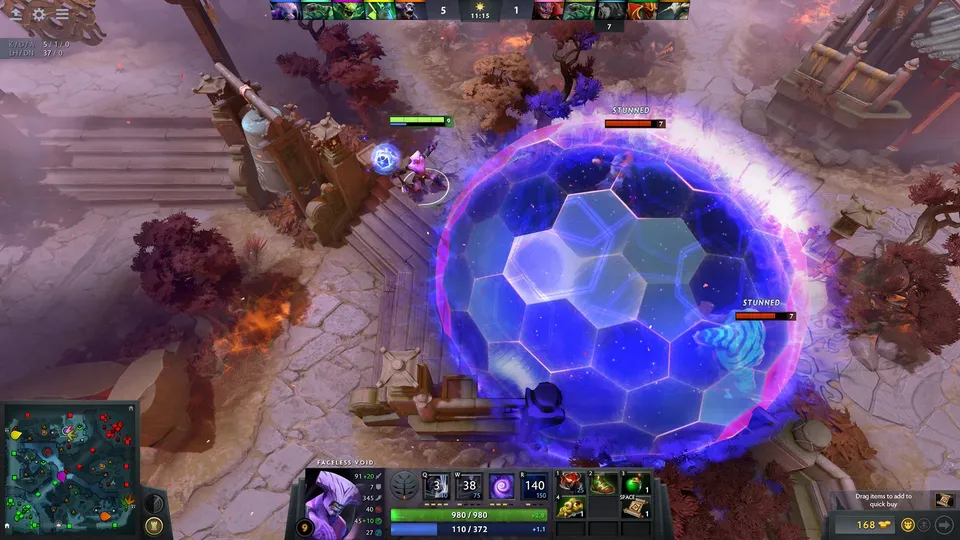
I’m playing Rubick. It’s minute thirty-four. The enemy Tidehunter just blinked into our backline and Ravaged three of us. Bad fight. We’re losing. Except I stole Ravage off the cast, blinked forward into the retreating Dire lineup, and dropped their own ultimate on top of them. Four-man stun. My carry cleaned up. We took Roshan off it and won the game six minutes later.
That play required: knowing Tidehunter’s cast animation well enough to position for the steal, having Blink Dagger off cooldown, reading the fight state fast enough to recognize the counter-engage window, aiming the stolen Ravage to catch the enemies who thought the fight was already won, and trusting that my carry would follow up without a ping or a word. Five layers of decision-making compressed into about two seconds.
This is what Dota 2 is. Not a game that’s complex by accident, but a game where complexity is the product. The thing you’re paying for. The reason it’s been running for over a decade with a playerbase that refuses to leave.
The Mechanical Density Is Unmatched
Every MOBA has abilities, items, and lane mechanics. Dota has those plus deny mechanics, turn rates, elevation advantage, day/night vision cycles, tree juking, stacking and pulling neutral camps, smoke of deceit, scan, Roshan timing, buyback gold management, teleport scroll cooldowns, Aghanim’s Shard upgrades, neutral item drops, and a courier system that requires actual thought.
That’s not a feature list. That’s the baseline. The stuff you need to understand before you can play the game at a basic level. And none of it is bloat — every one of those systems creates decision points that separate players of different skill levels.
Take denying. In League of Legends, you contest CS by threatening trades and managing wave state. In Dota, you do all of that plus you can kill your own creeps to deny your opponent gold and experience. This single mechanic transforms every laning interaction. A support who pulls the small camp at the right time can deny an entire wave of experience. A mid player who out-denies their opponent by ten creeps in the first five minutes has created a meaningful level and gold advantage through pure micro skill. It’s a mechanic that would be removed in most modern game designs because it “feels bad” for the person being denied. Dota keeps it because the skill expression it creates is worth the frustration.
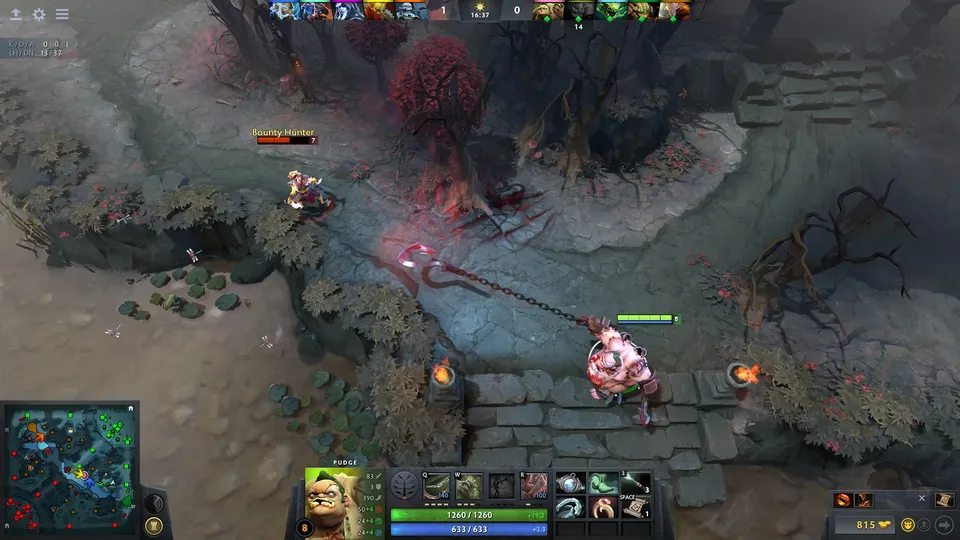
Turn rates are the perfect example of complexity that looks like jank but is actually genius. Heroes in Dota don’t instantly face the direction you click — they physically turn around, and different heroes turn at different speeds. This means melee heroes can body-block fleeing enemies. It means ranged heroes can’t effortlessly kite melee ones the way they can in League. It means a hero like Batrider, with his sticky napalm that slows turn rate, becomes a unique threat that couldn’t exist in a game with instant turning. The system looks clunky to new players. To experienced ones, it’s an entire axis of counterplay.
What Simpler MOBAs Trade Away
I’ve played League. I’ve played Heroes of the Storm. I’ve played Smite. I’ve messed around in Deadlock. I keep coming back to Dota, and the reason is that those games, for all their strengths, flatten the decision space in ways that make matches feel more similar to each other.
In League, the item system is a solved problem every patch. You look up a build, you buy those items in that order, and deviation is rarely rewarded. In Dota, the item system is a living puzzle. Do you rush Blink Dagger on Earthshaker for early pick potential, or do you build Arcane Boots first because your mana pool is a problem? Do you buy a Black King Bar this game, or is the enemy draft mostly BKB-piercing and you’re better off with a Linken’s Sphere? The right answer changes based on the draft, the game state, and what the enemy is building. I’ve played thousands of Dota matches and I still agonize over item builds because the correct choice is genuinely ambiguous.
Drafting in Dota is a game before the game. Five bans, five picks, with pick order creating asymmetric information that matters. A last-pick Broodmother into a lineup with no AoE clear is a different hero than a first-pick Broodmother that gets countered by three heroes. This is where cooldown trading starts — not in the game itself, but in the draft, where you’re trading strategic resources before anyone’s touched a creep. The hero pool is over 120, and unlike many roster-based games, even the oldest heroes remain competitively viable because Dota buffs the weak instead of only nerfing the strong.
The result is that Dota games feel different from each other in ways that other MOBAs don’t replicate. Not just “different heroes, same structure,” but fundamentally different game plans. A Broodmother push game plays nothing like a Spectre late-game scaling game plays nothing like a Chen early-aggression game. The strategic variance is enormous because the systems are deep enough to support it.
What Dota Gets Wrong
Dota’s new player experience is, to put it generously, hostile. The tutorial teaches you how to move and use abilities. It does not teach you how to pull creep camps, stack ancients, manage creep equilibrium, time Roshan, itemize against specific threats, or do any of the hundred other things that actually determine whether you win. You learn Dota by losing Dota for hundreds of hours, and the community you’re losing alongside is not known for its patience.
The smurf problem corrodes ranked play. Dota’s matchmaking has improved — phone number verification, behavior scores, stricter calibration — but a Divine player on a Crusader account still ruins eight other people’s game. Valve keeps throwing resources at it, but the problem is partially structural: in a game this complex, the skill gap between ranks is so vast that a smurf doesn’t just win, they make the match unplayable.
Match length is a real barrier. A Dota game averages 35-45 minutes, and some go past an hour. If you’re losing, you’re often locked into a slow bleed because there’s no surrender option in ranked until 30 minutes. Comebacks are real — that’s the philosophical defense. But the lived experience of being down 15k gold at minute twenty with no way out is one of the most soul-crushing feelings in competitive gaming.
And the visual clarity is a genuine problem. Dota teamfights at high levels are beautiful chaos — spell effects, particle systems, terrain destruction, summons. But for newer players, it’s just chaos. Figuring out what killed you or what you should have dodged requires replay analysis that most players will never do. Valve has improved this with health bar readability and ability indicators, but a five-on-five Dota teamfight remains one of the hardest things to parse in real time in any PVP game.
The International and Why It Matters
The International isn’t just an esports tournament. It’s a proof of concept. The Dota community crowd-funds prize pools through battle pass purchases — TI11 hit $40 million, the largest in esports history. That’s not Valve writing a check. That’s the playerbase putting money where their mouth is.
But TI’s real value is what happens on stage. Double elimination, best-of-five grand finals, and a meta that’s usually at peak diversity. Pocket strats hidden all year. Niche heroes pulled out for specific matchups. Late-game decisions that determine whether a million-dollar teamfight goes one way or the other. The OG back-to-back wins in TI8 and TI9. Alliance’s rat Dota in TI3. EG’s comeback against CDEC in TI5. These moments could only happen in Dota because the game’s complexity creates space for strategies no one has seen before, executed at a level a simpler game can’t produce.
The Playerbase Paradox
Here’s the tension at the heart of Dota 2: the complexity that makes it great is the same complexity that keeps it from growing. Dota’s monthly player count has been remarkably stable for years — hovering between 400-700k concurrent depending on the season — but it hasn’t meaningfully grown. New players bounce off the learning curve. Casual players find the time commitment prohibitive. Content creators struggle to make Dota accessible to audiences who don’t already play.
League solved this by meeting players halfway. Removing denies, simplifying item builds, adding a more guided new player experience, investing in accessibility. The result is a game with ten times Dota’s playerbase. Small games struggle to survive without massive playerbases, but Dota sits in an unusual middle ground: too complex to be mainstream, too established to die, funded by a community that values depth over accessibility.
Valve’s response has been characteristically Valve: do nothing dramatic. Ship patches. Balance heroes. Run TI. Let the game be what it is. No massive simplification patches. No new player campaigns. No aggressive monetization pivots. Just… Dota, continuing to be Dota, for the people who want it.
There’s something defiant about it. In an industry that chases the broadest possible audience and files down every rough edge, Dota 2 just sits there being the hardest major PVP game on the market. It doesn’t care if you bounce off. It’s built for the people who push through the 500-hour learning curve and find something on the other side that no other competitive game provides.
The Design Argument
Dota 2 makes a case that the rest of the industry has largely abandoned: that complexity itself is a feature. Not something to be managed or minimized, but something to be embraced and expanded. Every system Dota adds creates new interactions with every existing system. Every hero added to the pool creates new draft possibilities against every other hero. The game gets richer over time instead of more diluted, because the foundation is robust enough to support it.
Is Dota 2 for everyone? Absolutely not. It’s for the subset of PVP players who want the deepest possible competitive experience and are willing to invest the time to access it. But for that audience — and it’s a large, dedicated, decade-loyal audience — nothing else comes close.
The complexity is the point. It always was.

Discussion