
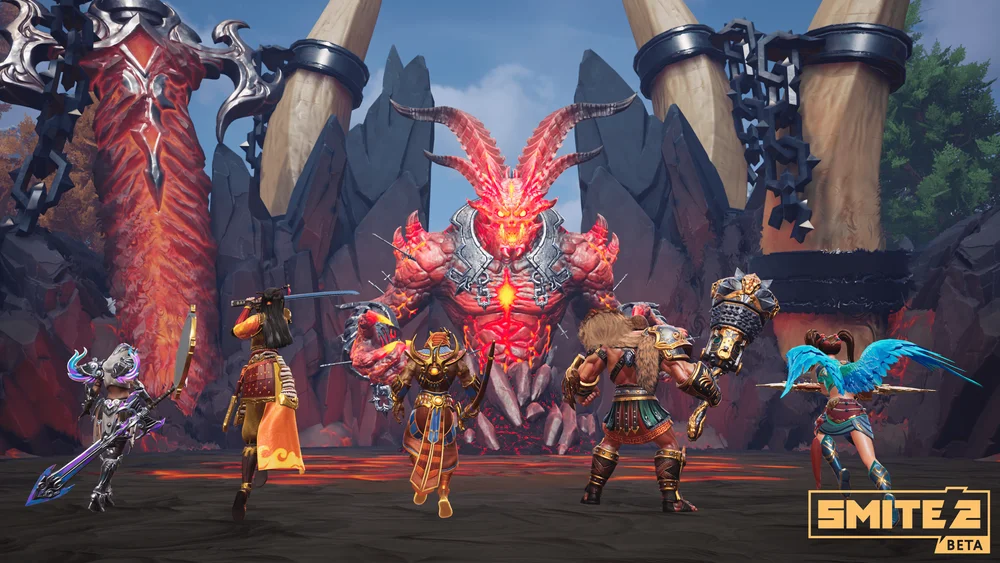
Every MOBA asks you to manage cooldowns, track enemy positions, and coordinate with your team. Most of them do it from a bird’s-eye view where you click the ground to move and abilities lock onto targets. Smite 2 does it from behind your character’s shoulder, with WASD movement, manual aiming on every single ability, and a camera that only shows you what’s in front of you.
That camera restriction changes everything. You can’t see the jungler sneaking behind you unless you physically turn around and look. You can’t snipe a skillshot across the map with perfect information — you have to read trajectories and lead your shots like you would in a shooter. It’s still a MOBA. You still lane, farm, build items, and teamfight over objectives. But the execution layer is fundamentally different from anything in League of Legends or Dota 2, and that difference is exactly what makes Smite 2 worth learning.
What Makes Smite 2 Different
The original Smite proved that third-person MOBAs could work. Smite 2 is Hi-Rez’s ground-up rebuild in Unreal Engine 5, carrying forward the core identity while modernizing everything around it — visuals, itemization, god kits, and onboarding.
Here’s what separates it from the rest of the genre:
Every ability is aimed manually. There is no tab-targeting. No point-and-click stuns. Your mage’s ultimate is a skillshot. Your support’s crowd control is a skillshot. Even basic attacks require you to aim a reticle at your target. If you miss, you miss. Mechanical skill matters in a way it simply doesn’t in traditional MOBAs. A perfectly-landed ability in Smite 2 is a read on your opponent’s movement, a prediction of their dodge, and clean execution under pressure.
The camera creates information asymmetry. In isometric MOBAs, both players see the entire lane and nearby jungle entrances. In Smite 2, your camera sits behind your god. You see what’s in front of you. Flanking actually works because the target literally can’t see you coming without rotating their camera. Jungle ganks are more visceral, more dangerous, and more rewarding to execute.
Movement is direct. WASD to move, mouse to aim. There’s no click-to-move pathing, no awkward right-click navigation around minion blocks. Your character goes where you tell it to go, immediately. This means juking — dodging enemy abilities through movement alone — is a core skill. You can sidestep a Ymir freeze on reaction if your movement is good enough. Try doing that in a click-to-move MOBA.
Relics replace summoner spells with active counterplay. Every player gets access to powerful active items — purification (CC cleanse), aegis (damage immunity), blink (instant teleport). Unlike League’s summoner spells with their 5-minute cooldowns, relics are on shorter timers and are central to moment-to-moment cooldown trading. Tracking enemy relic usage is one of the most important skills in competitive Smite.
How to Start: Roles and What They Actually Do
Smite 2 uses the standard five-role MOBA structure, but the third-person perspective changes how each role feels to play. Here’s what to expect and where to start.
Carry (ADC) — Start Here If You Like Shooters
The carry farms up in the duo lane and becomes the primary sustained damage dealer late game. In Smite 2, playing carry feels closest to a third-person shooter — you’re constantly kiting, spacing, and landing auto-attacks on moving targets.
This is the role I’d recommend if you’re coming from FPS or TPS games. The mechanical translation is the most direct. Gods like Neith and Chiron have forgiving kits with built-in safety that let you focus on learning the MOBA layer without getting punished for every positioning mistake.
Support — Start Here If You’re New to MOBAs
Counterintuitive advice, but hear me out. Support in Smite 2 is less about aim and more about positioning, timing, and reading the fight. You’re a tanky frontliner who initiates, peels, and controls space. Missing an ability as support is less punishing than missing one as carry or mage because your value comes from presence and decision-making, not damage output.
Ymir and Khepri are excellent starters. Ymir’s kit is straightforward (wall, freeze, slow, big damage ult), and Khepri’s ultimate literally revives a teammate. Playing support also teaches you the map, objective timers, and match flow faster than any other role because your job is to watch the whole game, not just your lane.
Mid, Jungle, Solo — The Deep End
Mid lane mages require consistent skillshot accuracy. Jungle requires map awareness, gank timing, and the ability to land burst combos in tight windows. Solo lane is an island — tanky bruisers brawling 1v1 for five minutes before teleporting into a teamfight. All three are great once you understand the basics, but they’ll punish you hard if you don’t.
My honest recommendation: play 20 games of carry or support before touching these roles. Learn how the map works first. Then graduate into the positions that demand more.
The Meta in 2026: What the Game Rewards
Smite 2’s current meta rewards aggression and objective control over passive farming. Shorter match times and more frequent teamfight triggers compared to original Smite. Here’s what that means in practice:
Early pressure matters. The team that wins the first few minutes tends to snowball through objective control. Farm efficiency is important, but sitting in lane and last-hitting isn’t enough. You need to be looking for rotations, invades, and early Gold Fury contests.
Frontline composition wins games. Two tanks plus a bruiser solo laner gives your team so much space. The meta consistently favors compositions that can initiate fights and absorb damage while the backline does their job. If your ranked team is locking in five damage dealers, you’re losing in draft.
Relic timing decides teamfights. When a carry burns their aegis, they are killable for the next 90+ seconds. When a support uses their blink to engage, they can’t blink out. Good Smite players track enemy relic cooldowns the way League players track summoner spells, and they call fights around those windows. Start doing this early and you’ll climb faster than almost any other habit.
Build adaptation is rewarded. The item system encourages situational building over cookie-cutter paths. Anti-heal, penetration type, and defensive options matter. Copying a pro build without understanding why they built those items will lose you games against players who counter-build.
Common Mistakes and How to Fix Them
I’ve watched a lot of new Smite players struggle with the same things. Here’s the shortlist:
Tunnel vision. The third-person camera makes it easy to fixate on whatever’s directly in front of you. That jungler flanking from behind? You didn’t see them because you didn’t check. Get in the habit of rotating your camera periodically, especially when pushing up in lane. The minimap exists — use it between every ability cast.
Standing still while casting. In Smite 2, you can move while casting most abilities. New players freeze up during ability casts, standing perfectly still, making themselves easy targets. Practice strafing while you throw abilities. It becomes second nature after a few days, and it dramatically reduces how much damage you take.
Ignoring the jungle. Farm isn’t just in your lane. Jungle camps and neutral objectives are critical income sources that many new players walk right past. Clear your camps between waves. Contest the enemy jungle when you have lane priority. Smite rewards players who efficiently farm the entire map, not just their assigned lane.
Fighting without relics. If your purification and aegis are both on cooldown, you should not be in a position where you can be engaged on. Relic cooldowns are your safety net — without them, you’re one CC chain away from dying. Play safe when they’re down.
Not warding. Wards are even more important here than in top-down MOBAs because of the camera restriction. A ward in the jungle entrance gives you information you literally cannot get any other way. Buy wards. Place wards. The support can’t ward the entire map alone.
Why Smite 2 Is Worth Your Time in 2026
The MOBA space has more options than ever. Deadlock is merging MOBA mechanics with shooter gameplay. League and Dota dominate the isometric space. So why Smite 2?
Because nothing else feels like it. The third-person perspective isn’t a gimmick — it’s a genuinely different way to experience MOBA mechanics that emphasizes mechanical execution, spatial awareness, and moment-to-moment decision making. Every kill feels earned because you aimed for it. Every death teaches you something because you can see exactly where your positioning or camera awareness failed.
The mythology angle gives it real personality. Playing as gods from Greek, Norse, Egyptian, Hindu, and Japanese pantheons creates a roster where every character has cultural weight. When Thor throws his hammer, it feels like Thor throwing his hammer. You develop attachment to characters that have thousands of years of storytelling behind them.
Hi-Rez has also clearly learned from the original Smite’s growing pains. The matchmaking has been rebuilt, the tutorial actually teaches you how to play, and the new player experience respects your time without overwhelming you with systems.
The skill ceiling is enormous. Auto-attack canceling, ability combos, jungle timers, team composition theory, matchup-specific laning strategies — even after hundreds of hours, there’s more to learn. If you want a competitive game where improvement is always visible and always rewarding, Smite 2 delivers in a way that feels fresh even if you’ve been playing MOBAs for a decade.
If you’re brand new to competitive PVP entirely, our arena brawler beginner’s guide covers universal concepts — cooldown tracking, positioning, target prioritization — that transfer directly into Smite 2. The fundamentals are the same. Smite just asks you to aim while you’re applying them.



Discussion