
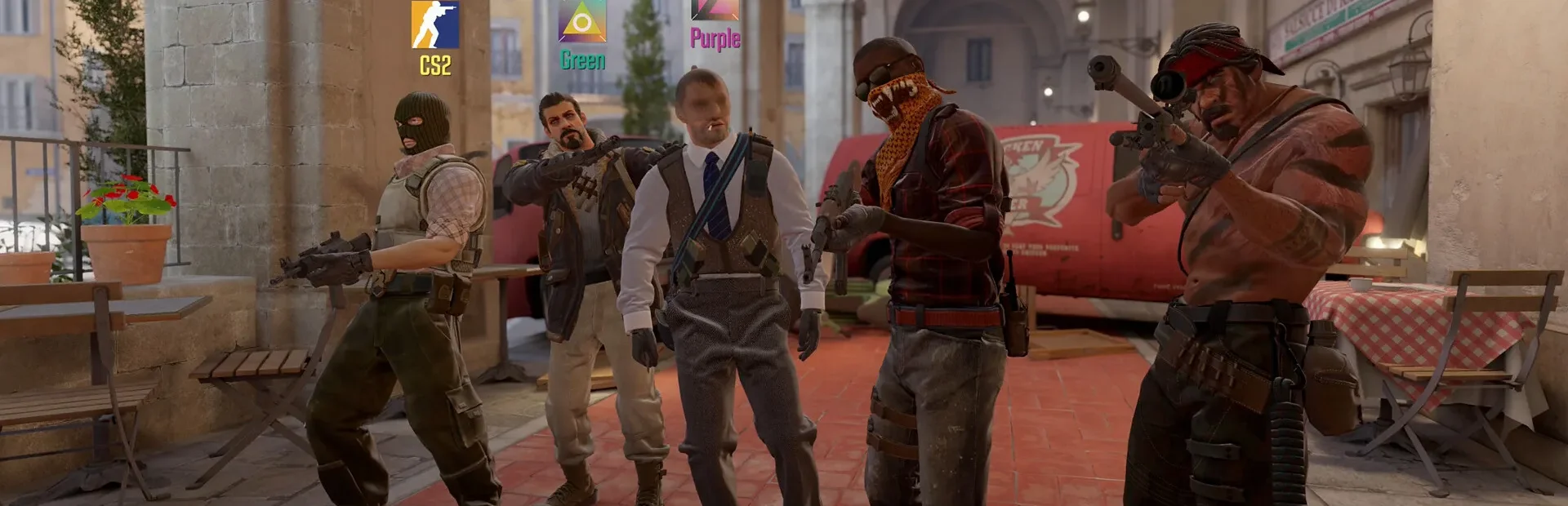
The tactical shooter is the most demanding PVP genre in gaming. No respawns to bail you out. No ultimate charging in the background to swing the round for free. You peek, you get one chance, and the result is your fault — good or bad. That pressure is what makes the genre addictive for the people who love it and brutally unwelcoming for everyone else.
This list ranks the 20 best tactical and competitive shooters you can play in 2026. It’s ordered by how much each game rewards competitive investment — the combination of skill ceiling, community health, developer commitment, and how satisfying the game feels when you’re actually good at it. Some of these games are massive esports. Some are niche gems with 2,000 concurrent players. Some are dead and deserve to be remembered anyway. All of them reward the same core instinct: think before you shoot.
The Top Tier
1. Counter-Strike 2
Developer: Valve | Team Size: 5v5 | Price: Free-to-play
There’s nothing left to say about Counter-Strike that hasn’t been said before, so here’s what matters in 2026: it’s still the best. The Source 2 engine has matured past the rocky transition period. The sub-tick system is responsive. The smoke grenades are volumetric now, which means you can use an HE grenade to punch a temporary hole in a smoke — a mechanic that added genuine new depth to a 25-year-old game without changing its identity.
What CS2 does better than every other game on this list is clarity of feedback. When you die, there is no ambiguity. You didn’t get CC-chained. Nobody pressed Q to become invulnerable. A person put their crosshair on your head faster than you put yours on theirs. That honesty is brutal and it’s the reason the genre exists. Every other game on this list is, in some way, a variation on what Counter-Strike established.
The criticism: Valve’s communication is still glacial. Balance patches arrive without explanation. The competitive ecosystem outside of tier-one esports has thinned. If you don’t have a five-stack, the solo queue experience can be rough — and the trust factor system still feels opaque.
For you if: You want the purest test of aim, positioning, and game sense in the genre. You understand that dying in 0.2 seconds is information, not frustration.
2. Valorant
Developer: Riot Games | Team Size: 5v5 | Price: Free-to-play
Valorant’s genius is that it found a middle ground nobody thought existed — CS-style gunplay fused with hero abilities that feel like tactical utility rather than crutches. Five years in, the agent roster has expanded enough that team composition is a genuine strategic layer. A Sova recon dart clearing a site is functionally a teammate risking utility economy to give you safe information. A Viper wall splitting a bombsite in half forces defenders to choose which angles to concede. These aren’t damage buttons. They’re tactical decisions with resource costs.
The ranked system is among the best in competitive gaming. The premier mode gives you a clear number. The netcode is solid and the anti-cheat — love it or hate it — keeps the playing field cleaner than any other competitive FPS. The map design has gotten significantly better since launch; newer maps like Lotus and Abyss have multiple levels of complexity that reward creative utility use.
The criticism: Some agents have abilities that edge too close to “press button, win space” — especially at lower ranks where utility usage is sloppy and duelist kits become crutches rather than entry tools. Kernel-level anti-cheat is a real privacy concern. And the spray patterns, while intentionally simpler than CS, create a lower mechanical ceiling for pure gunplay.
For you if: You want tactical shooting with variety. You like the idea of every round being a puzzle where your agent pick is one of the variables. You’re okay with Riot running a rootkit on your machine because you’re tired of cheaters.
3. Rainbow Six Siege
Developer: Ubisoft Montreal | Team Size: 5v5 | Price: $8-20
Siege is the thinking player’s tactical shooter. The preparation phase — where defenders reinforce walls, place gadgets, and set up crossfires while attackers send drones to gather intel — creates a strategic layer that no other game on this list replicates. Every round starts with a planning phase where information is the most valuable resource, and the thirty seconds before anyone fires a bullet are often where the round is actually won or lost.
The destructible environments are more controlled than The Finals but deeper in their competitive implications. A Thermite breach on a specific reinforced wall on Oregon basement is a studied set play with known counter-positions, known rotate holes, and known Bandit trick timings. That kind of depth — where a single wall becomes a micro-game between attacker and defender — is unique to Siege and it’s what keeps the competitive scene alive a decade after launch.
The criticism: The operator bloat is real. New players face 60+ operators and have no idea which ones matter. Ubisoft has struggled with balancing the roster, and the seasonal content has slowed. The learning curve is genuinely steep — you’ll get spawn-peeked through a window you didn’t know existed for your first fifty hours. And the casual mode population has thinned, which means even “unranked” matches are sweaty.
For you if: You want a tactical shooter where intel wins rounds more than aim. You enjoy a steep learning curve. You want destruction that’s predictable enough to strategize around.

4. Escape from Tarkov
Developer: Battlestate Games | Team Size: Variable | Price: $45-150
Tarkov isn’t a tactical shooter in the traditional round-based sense, but its gunplay is the most tactical in any FPS. The ballistics model accounts for bullet velocity, drop, penetration values per armor class, and fragmentation chance. Choosing between M855A1 and M995 for your M4 isn’t cosmetic — it’s the difference between your rounds bouncing off a level 5 armor plate and punching through it. No other game on this list makes ammunition selection a strategic decision with life-or-death consequences.
The extraction format means every engagement is a risk calculation. That geared player you hear in the next room might have 600,000 rubles of equipment. Kill him, extract with it, and you’ve funded your next five raids. Die, and you lose everything you brought in. This creates a tension that round-based shooters fundamentally cannot match — the stakes are real because the loss is real.
The criticism: The monetization is predatory. The Edge of Darkness edition drama fractured the community. Performance is inconsistent. The learning curve isn’t a curve, it’s a cliff — new players will spend their first twenty hours dying to enemies they never see while trying to figure out which extraction point they’re supposed to reach. And Battlestate’s communication makes Valve look transparent.
For you if: You want gunfights where your hands shake because losing means losing your gear. You enjoy the preparation of building a loadout as much as the fight itself. You have a high tolerance for jank.
5. The Finals
Developer: Embark Studios | Team Size: 3v3v3 | Price: Free-to-play
The Finals asks a question no other tactical shooter asks: what if the map was temporary? Not destructible walls in controlled locations like Siege, but physics-driven destruction where you can collapse an entire floor and everything on it — players, objectives, furniture — crashes through to the level below. The first time you C4 the floor beneath a cashout station and drop the entire fight down a story, you understand what this game is offering that nothing else can.
The three-class system creates distinct relationships with destruction. Heavies reshape the environment. Mediums adapt to whatever geometry exists. Lights exploit the chaos. The team composition isn’t just about abilities — it’s about how your squad interacts with a map that’s disintegrating in real time. By the final minutes of a match, you’re fighting in the skeleton of a building, improvising cover from debris.
The criticism: The ranked mode has never quite found its footing. The game show aesthetic turns off players looking for something more grounded. Balance between the three classes fluctuates wildly between seasons. And the three-team format means you can play a perfect round and still lose because the third team showed up at the worst possible moment. That chaos is the appeal for some and the dealbreaker for others.
For you if: You’re tired of fighting on the same static maps for the hundredth time. You want a shooter where creativity matters as much as aim. You find it funny when the building you’re defending ceases to exist.
The Strong Middle
6. Insurgency: Sandstorm
Developer: New World Interactive | Team Size: Up to 16v16 | Price: $30
Insurgency occupies the sweet spot between arcade shooter and milsim that almost nobody else targets. The time-to-kill is brutally fast — one or two bullets from most rifles. There’s no crosshair by default. Recoil is heavy and weapon-specific. But the maps are designed for infantry combat at playable ranges, and rounds are short enough that dying doesn’t mean waiting five minutes.
The weight system is the underrated gem. Every piece of equipment affects your movement speed and stamina. A player running light with an AKM and two magazines moves noticeably faster than someone kitted in heavy armor with an M249. That tradeoff creates meaningful loadout decisions that Call of Duty’s create-a-class system only pretends to offer.
The criticism: The population is modest and declining. Co-op pulls players away from PVP. Matchmaking can be slow in off-peak hours.
For you if: You want a shooter that punishes carelessness with instant death but doesn’t require a three-hour milsim commitment. You enjoy the sound of bullets cracking past your head.
7. Squad
Developer: Offworld Industries | Team Size: 50v50 | Price: $50
Squad is the milsim that actually plays well as a game. Squad leaders coordinate through a command channel while individual squads use proximity and radio chat — creating a command structure that feels organic. A good squad leader calling targets and coordinating supply drops produces a teamwork experience no other game matches. A bad one produces chaos, which is also realistic.
The logistics system sets Squad apart. FOBs need to be built and supplied — someone has to drive a truck from main base. Destroying an enemy FOB isn’t just removing a spawn; it’s severing a supply line. The players who understand that meta are worth more than the best aimers on the server.
The criticism: You need a mic. Solo queue without comms is miserable. The learning curve is steep and none of it is tutorialized well. Some rounds are thirty-minute slogs defending a point nobody attacks.
For you if: You want teamwork to be the core skill, not a supplement to aim. You find the logistical side of warfare as interesting as the shooting.
8. Hell Let Loose
Developer: Black Matter | Team Size: 50v50 | Price: $40
World War 2, 50v50, on maps scaled to real historical battlefields. When your team pushes across an open field and half your squad gets mowed down by a machine gun nest you can’t see, it captures the WW2 tactical fantasy that Call of Duty never has and never will.
The commander role — one player per team managing resource allocation, supply drops, and bombing runs — adds a genuine RTS layer to the FPS. Good commanders win games. Bad commanders lose them. One player’s strategic decisions affecting fifty teammates is both the game’s greatest strength and its greatest vulnerability.
The criticism: Performance is rough. Hit registration is inconsistent. The community is aging. Your match quality depends on whether one random person on your team knows how to play commander.
For you if: You want a WW2 shooter that feels like a war, not an arena. You’re patient enough to walk five minutes to the front because someone forgot to build a garrison.

9. Spectre Divide
Developer: Mountaintop Studios | Team Size: 3v3 | Price: Free-to-play
The newest game on this list and the one most likely to move up or down by the end of the year. Spectre Divide’s core innovation is the duality system — every player controls two bodies. Your main character and a “spectre” that you can position independently, then swap to at any time. This means every player is holding two angles simultaneously, and the mind games of when to swap — baiting a peek with one body while the other holds the trade angle — create a mechanical and strategic layer that has no equivalent in any other tactical shooter.
The 3v3 format keeps rounds tight and readable. With fewer players, individual skill and decision-making are more impactful. The gunplay is clean — clearly influenced by Valorant and CS2 — and the maps are designed around the duality mechanic with verticality and sightlines that reward creative spectre placement.
The criticism: The population is still finding its footing. The spectating experience is confusing — six bodies controlled by three players per team is difficult to read as a viewer, which hurts competitive broadcasting potential. Some duality mechanics feel exploitable at high levels, and it’s unclear whether Mountaintop can balance around them long-term. The game needs more maps and more time to prove itself.
For you if: You want to try something genuinely new in the tactical shooter space. You enjoy games where mechanical innovation creates unexplored strategic territory. You’re comfortable being an early adopter.
10. Ready or Not
Developer: VOID Interactive | Team Size: 1-8 co-op (PvP modes available) | Price: $40
Ready or Not isn’t primarily a PVP game, and that’s precisely why it earns a spot on this list. The SWAT-simulation gameplay — clearing rooms, checking corners, managing rules of engagement — creates tactical discipline that bleeds into every other shooter you play. After fifty hours, you’ll never mindlessly sprint through a doorway again.
The AI suspects are unpredictable in a way that approximates human opponents. They hide in closets. They pretend to surrender, then pull a weapon. The mechanical demands — mirror guns, flashbang timing, threat communication — create a tactical vocabulary that transfers directly to PVP.
The criticism: PVP modes feel secondary. Content has expanded slowly. If you want ranked modes and good matchmaking, this isn’t it. If you want a tactical training ground that makes you better at every other game on this list, it’s excellent.
For you if: You want to develop habits that transfer to every other FPS. You enjoy co-op tactical play that rewards patience and methodical execution.
The Niche Picks
11. ARMA Reforger
Developer: Bohemia Interactive | Team Size: Variable (up to 128) | Price: $30
ARMA is the granddaddy of milsim, and Reforger is the Enfusion engine proving ground for ARMA 4. What ARMA does that no other game replicates is authentic engagement distances. Firefights happen at 300-600 meters. Identifying an enemy at that range, estimating bullet drop, accounting for wind, and landing a shot is a skill set that doesn’t exist in any game higher on this list.
The criticism: It’s ARMA. Arcane controls, inconsistent performance, stiff infantry gunplay. The modding community carries most content. And Reforger is explicitly a bridge to ARMA 4 — investing in a self-described stepping stone is a tough sell.
For you if: You want the most authentic military simulation available. You have a community to play with. You enjoy engagements measured in hundreds of meters.
12. Ground Branch
Developer: BlackFoot Studios | Team Size: 8v8 | Price: $30 (Early Access)
The indie spiritual successor to the original Rainbow Six and Ghost Recon games — the ones from 2001, before Ubisoft turned them into arcade shooters. Ground Branch is about planning, not reacting. You choose your gear down to the specific magazine type, plan your approach on a map overview, and execute methodically. The movement is deliberate. The time-to-kill is instant. Checking a corner incorrectly is death.
The small development team means updates are slow, but each one is focused on mechanical fidelity rather than content volume. The weapon handling — clearing malfunctions, choosing between speed and precision reloads, managing your stance for stability — is as detailed as any shooter ever made. This is a game made by people who care about the craft of tactical gameplay at a granular level.
The criticism: Early Access for years with a tiny team. Population hovers in the hundreds. No matchmaking — it’s server browser only. The production values are indie-level, which means you’ll be playing on maps that look a generation behind anything from a major studio. And the pace is so deliberate that many players bounce off it within the first hour.
For you if: You miss the old Rainbow Six planning phase. You want tactical gameplay that prioritizes preparation over reflexes. You’re willing to join a niche community and play on their terms.
13. Pavlov VR
Developer: Vankrupt Games | Team Size: 5v5 (+ custom modes) | Price: $25
The game that proved tactical shooters work in VR. Pavlov takes the CS formula — buy phase, round-based, bomb defusal — and translates it into virtual reality without dumbing anything down. Reloading means physically ejecting the magazine, inserting a new one, and racking the charging handle. Grenades are thrown with your actual arm. The skill gap between a new VR player fumbling a reload and a veteran swapping magazines in under two seconds is enormous.
Community servers keep Pavlov alive far beyond its competitive core — TTT, zombie survival, WW2 modes, and thousands of custom maps.
The criticism: VR is niche. Competitive matches require Discord, not matchmaking. The Quest version is significantly downgraded from PCVR.
For you if: You own a VR headset and want the most competitive multiplayer experience available for it. You want to know what tactical shooting feels like when reloading is a physical skill.
14. Zero Hour
Developer: M7 Productions | Team Size: 5v5 | Price: $13
The budget Rainbow Six Siege. Zero Hour lifts Siege’s core gameplay loop — attackers breach, defenders fortify, destruction-based gameplay with gadgets and intel — and delivers it at a fraction of the price with a smaller but passionate community. The maps are smaller and more focused than Siege’s sprawling sites, which makes rounds faster and the learning curve less vertical.
What Zero Hour does well is distill Siege’s formula to its essential elements. There are fewer operators, fewer gadgets, and fewer variables — which means new players can be competitive faster. The destruction is meaningful but manageable. The intel game exists but doesn’t require memorizing sixty operator abilities. It’s Siege for people who think Siege has too much stuff.
The criticism: The production quality is visibly indie. Animations are stiff. The sound design lacks the spatial precision that makes Siege’s audio a genuine gameplay tool. The population is small and concentrated in specific regions — off-peak queues can be painful. And the game lives in Siege’s shadow, which means every comparison highlights what it’s missing rather than what it does well.
For you if: You like Siege’s concept but find Siege itself overwhelming. You want a budget tactical shooter with destruction mechanics. You don’t mind small communities.

15. World War 3
Developer: The Farm 51 | Team Size: 20v20 | Price: Free-to-play
World War 3 is the Battlefield game that DICE stopped making. The gunplay is weightier than Battlefield 2042. The weapon customization — building guns from individual components that affect handling — gives loadout decisions tactical weight. Maps based on Warsaw, Berlin, and Moscow sit at a scale between Squad’s enormous battlefields and Battlefield’s condensed lanes.
The criticism: The game nearly died. A disastrous early access launch decimated the community, and the free-to-play relaunch only partially recovered it. Optimization, server stability, and hit registration still need work. It’s a good game trapped in a troubled history.
For you if: You miss Battlefield 3 and 4. You want large-scale combined arms with tactical gunplay and don’t mind slow matchmaking.
16. Caliber
Developer: 1C Game Studios | Team Size: 4v4 | Price: Free-to-play
The most interesting tactical shooter nobody in the West talks about. Caliber is a third-person, class-based game with operators drawn from real-world special forces. The four classes — Assault, Support, Medic, Marksman — create defined roles, and the third-person perspective adds corner-peeking dynamics that first-person games intentionally avoid. The emphasis on cooperative abilities is closer to what Valorant does with agent utility than what Siege does with gadgets, but the perspective shift changes the spatial math entirely.
The criticism: Primarily popular in Russia and Eastern Europe — Western populations are thin. Monetization pushes toward paid operator unlocks. Third-person is a dealbreaker for FPS purists.
For you if: You want a tactical shooter that does something different with perspective and class design. You’re comfortable with smaller communities.
17. Contractors
Developer: Caveman Studio | Team Size: 5v5 | Price: $20
If Pavlov is CS in VR, Contractors is the Call of Duty answer — faster-paced, more accessible, and with arguably the best gunfeel in any VR shooter. Every gun feels distinct through physical interactions: grabbing magazines from your chest rig, racking charging handles, flipping sights. The mod support through mod.io has transformed Contractors into a platform — Star Wars maps, Halo weapons, historical scenarios keep it fresh indefinitely.
The criticism: Same VR caveats as Pavlov — niche market, small competitive population, Discord-dependent matchmaking. Base content without mods is limited.
For you if: You own a VR headset and want the best gunfeel in VR. You prefer faster-paced combat over Pavlov’s deliberate pace.
18. Due Process
Developer: Giant Enemy Crab | Team Size: 5v5 | Price: $25
The most creative tactical shooter concept that never found its audience. Due Process generates maps procedurally — the layout is different every match, so memorized angles are impossible. Both teams get a planning phase where they draw on the map and coordinate an approach to a layout nobody has seen before. This eliminates the biggest gap between veterans and newcomers: map knowledge. The drawing-on-the-map phase is one of the most delightful team communication tools ever put in a multiplayer game.
The criticism: The population is essentially dead — a cautionary tale about how matchmaking needs critical mass. Procedural maps occasionally feel awkward in ways hand-crafted maps never would. Due Process is here because the idea deserves to be remembered and stolen by a game with more resources.
For you if: You can find matches (check Discord) and want the most original tactical shooter map design ever made.
19. Isonzo
Developer: BlackMill Games | Team Size: 24v24+ | Price: $30
The WW1 tactical shooter that replaced Verdun as the definitive entry in an extremely niche subgenre. Isonzo recreates the Italian Front with period-accurate weapons and a class system built around WW1 military roles. What it captures is the terror of WW1 combat — crossing no-man’s land under machine gun fire, huddling in a trench while artillery hammers ahead, fixing bayonets because the enemy is ten meters away and there’s no time to reload. The bolt-action gunplay makes every shot consequential in a way automatic weapons never can.
The criticism: WW1 shooters are niche within a niche. The pace is glacial by modern standards. Population is small and region-dependent.
For you if: You want bolt-action rifles as the primary weapons. You find the WW1 setting compelling rather than limiting.
20. XDefiant
Developer: Ubisoft | Team Size: 6v6 | Price: Free-to-play
XDefiant is Ubisoft’s attempt to make a competitive shooter using Tom Clancy factions, and it lands between “surprisingly decent” and “why does this exist.” The gunplay is better than it has any right to be — snappy, responsive, with meaningful recoil variety. The faction system pulls from Splinter Cell, Ghost Recon, The Division, and Far Cry, giving each role a distinct utility set. For players who want something between Call of Duty’s chaos and Valorant’s cerebral pacing, XDefiant hits a tempo that works.
The criticism: It struggles with identity. Faction theming feels like a marketing exercise. The competitive scene hasn’t materialized despite Ubisoft’s investment. Content updates are steady but uninspired. In a market with CS2 and Valorant, “pretty good” doesn’t build a dedicated community. XDefiant is a solid shooter that might not have a reason to exist in a year.
For you if: You want a free, accessible tactical-adjacent shooter without hundreds of hours of investment. You want something lighter than Valorant but more structured than Call of Duty.
How to Choose Your Tactical Shooter
Twenty games is a lot. Here’s how to narrow it down based on what you actually want.
If you want the purest competitive experience: Counter-Strike 2 or Valorant. These are the two games where the competitive infrastructure — ranked modes, anti-cheat, community size, esports ecosystem — is mature enough that your investment will pay off. CS2 if you want raw aim to be king. Valorant if you want hero utility to add strategic variety.
If you want tactical realism without a three-hour time commitment: Insurgency: Sandstorm. Fast rounds, lethal gunplay, no minimap hand-holding. It’s the sweet spot between arcade and milsim that most games can’t hit.
If you want large-scale teamwork: Squad for modern combined arms, Hell Let Loose for WW2, ARMA Reforger for full military simulation. The time commitment scales upward in that order — Squad rounds are ~45 minutes, HLL matches are ~90, ARMA operations can run for hours.
If you want something genuinely new: Spectre Divide (duality mechanic), The Finals (destruction-as-gameplay), or Due Process (procedural maps, if you can find players). These games are experimenting with the tactical shooter formula in ways that the market leaders aren’t.
If you own a VR headset: Pavlov for the CS-style competitive loop, Contractors for the best gunfeel in VR.
If you want to get better at every other game: Ready or Not. The habits you develop clearing rooms — checking corners, managing angles of exposure, communicating threats — transfer to every other game on this list.
Whatever you choose, the tactical shooter genre rewards commitment more than any other in gaming. The first ten hours will be frustrating. The first fifty will be educational. Somewhere after a hundred, the game stops being something you play and starts being something you understand. That’s when it becomes worth it.
For our full ranking of competitive games across all genres — fighters, MOBAs, hero shooters, and more — check out The Best PVP Games to Play in 2026.


Discussion