
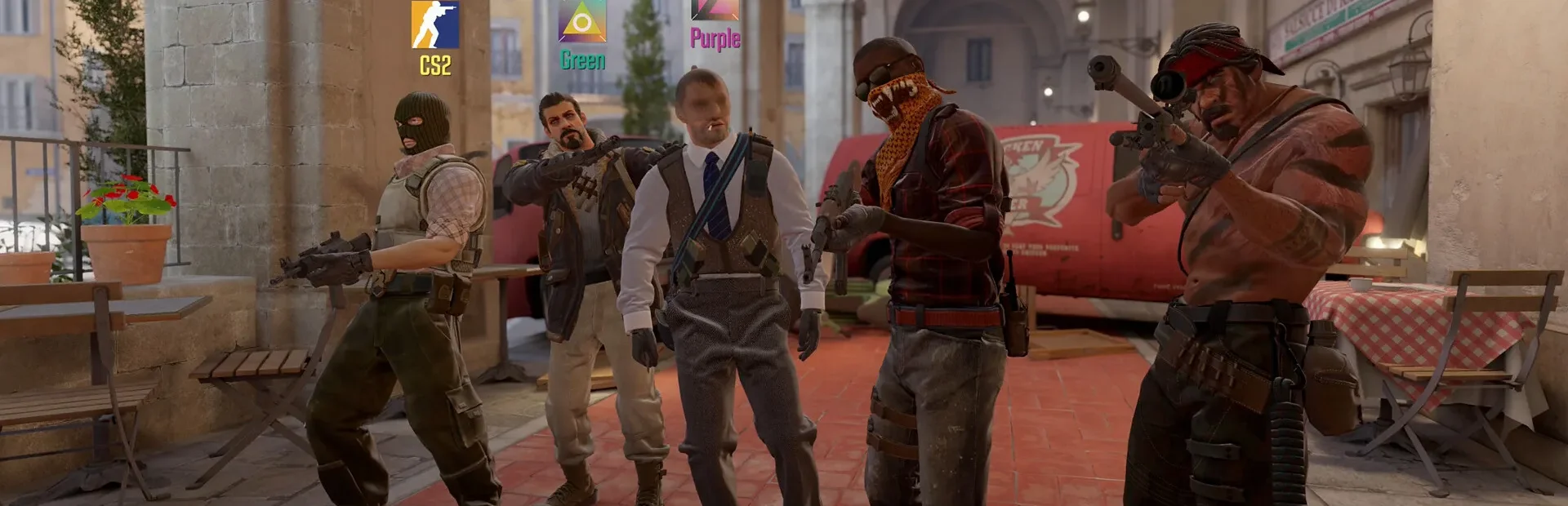
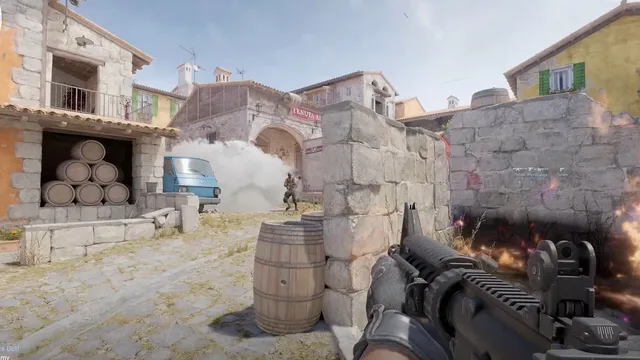
It’s a 1v3 on Inferno. You’re holding B site with an M4, 43 HP, no utility left. The first guy swings car — you counter-strafe, tap twice, headshot. The second peeks construction while you’re still exposed. You jiggle back behind the pillar, let him commit to the wide angle, then swing and spray-transfer from his chest to his head in four bullets. The third hears his teammates die, panics, and pushes with a flash. You turn away, catch the edge of the blind, and one-tap him through the fading white. Thirteen seconds. Three kills. Pure aim, positioning, and the fact that you knew how this game’s movement works down to the pixel.
No ability saved you. No ultimate tipped the fight. No cooldown came off at the right time. You won because you shot better and moved better, and the game gave you absolutely nothing else to lean on.
That is Counter-Strike. That is why it has outlasted every tactical shooter built to kill it for a quarter century. Not because it innovates. Because it refuses to.
The Gunplay Contract
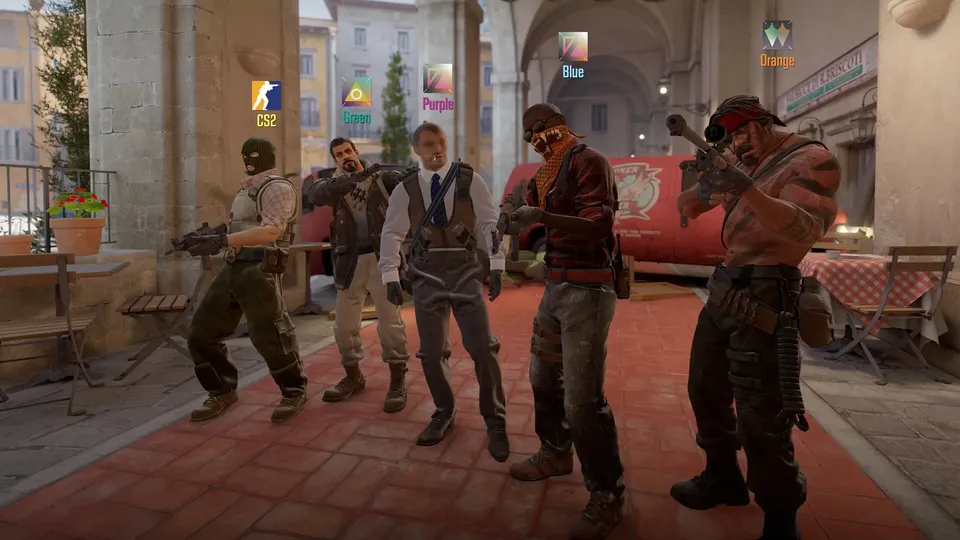
Counter-Strike’s shooting model is built on a promise almost no other modern shooter makes: if you are standing still and aiming at someone’s head, the bullet goes where you’re pointing. Every time. No spread bloom. No hidden accuracy stat tied to your legend pick. The bullet goes where the crosshair is.
Everything extends from that commitment. Movement degrades accuracy — not as a vague penalty, but as a steep, predictable curve that turns running into missing. Counter-strafing (tapping the opposite movement key to instantly zero your velocity) exists because the game rewards you for understanding this curve. The skill isn’t just clicking heads. It’s knowing the exact frame when your velocity hits zero and your accuracy becomes perfect, then clicking the head during that frame.
Spray patterns add the second layer. Every weapon has a fixed recoil pattern — the AK-47 pulls up and to the right the same way every time. Learning to control it takes months. Spray transfer — controlling the pattern while snapping between two targets — is one of the hardest mechanical skills in any competitive shooter. It’s not random or stat-dependent. It’s a physical skill you develop through repetition, and the game never takes it away from you.
This is the polar opposite of what Apex Legends does with movement expression or what Overwatch does with hero abilities. Those games add variables that create moments where you win or lose based on resource management rather than raw execution. Counter-Strike strips those variables out. When you die, you got outshot, outpositioned, or out-utilited. The game gives you nowhere to hide from that.
Economy as the Meta-Game
The buy system is Counter-Strike’s version of cooldown trading — except instead of tracking ability timers, you’re trading money across rounds. Every round starts with a buy phase where your team decides how to spend accumulated cash on weapons, armor, and grenades. Win rounds, earn more. Lose rounds, earn less. Die with an expensive rifle, lose it.
A full buy costs $5,000-$6,000 per player. Lose the pistol round and a force buy, and you’re stuck on $2,000 each — enough for SMGs, not enough to compete evenly. So you eco: buy nothing, accept the probable loss, bank money for next round. Force buys are the gamble in between — spending more than you should, banking on the chance that an upset steals the enemy’s rifles and wrecks their economy.
The depth compounds. A dropped AWP ($4,750) in a recoverable position swings the economy for multiple rounds. A $300 molotov that forces a $4,750 AWPer off an angle is one of the best trades in the game. Reading these resource trades correctly is what separates a team that wins 50% of their duels from a team that wins tournaments.

Maps Are the Content
Counter-Strike doesn’t ship heroes or new guns every season. It ships maps. And those maps are some of the most refined competitive spaces in gaming.
Inferno’s banana is one of the most studied 30 meters of virtual real estate in competitive gaming. The angles, the molotov lineups, the timing of the smoke to block CTs from pushing — teams spend hours developing executes for a single chokepoint. That depth doesn’t come from complexity. It comes from simplicity: the space is readable, the angles are learnable, and the skill expression lives in how precisely you use utility within terrain you’ve seen a thousand times.
This is map design as skill amplifier rather than content treadmill. Valve doesn’t need to rotate maps every season because the maps are deep enough that teams are still finding new utility lineups years after release. When a new map does enter the Active Duty pool, the community dissects it for months. The geometry is the content.
What Source 2 Actually Changed
The Source 2 upgrade was announced as a revolution and arrived as something more interesting: targeted improvements to the systems competitive players actually cared about.
Sub-tick networking is the headline. CS:GO evaluated actions at a fixed tick rate — 64 or 128 per second. Shots between ticks got rounded. CS2 evaluates the exact timestamp of your input regardless of tick rate. Over hundreds of rounds, the consistency compounds into a game that feels measurably more fair.
Volumetric smokes changed the utility metagame. Smokes fill spaces dynamically and can be partially cleared by HE grenades. Shooting through one creates a visible hole, briefly revealing what’s behind it. The tools became interactive rather than binary.
Premier mode gave ranked play a visible Elo number instead of CS:GO’s vague rank icons. Transparent rating systems build trust — when you can see the number, the “rigged matchmaking” conspiracies lose most of their power.
What Valve Gets Wrong
Counter-Strike 2 has problems, and most of them share a common root: Valve’s institutional allergy to communication.
The anti-cheat situation is a perpetual sore point. VAC has historically been less aggressive than Riot’s Vanguard (kernel-level, always running). The tradeoff is real — Valve doesn’t want to run kernel-level software on your machine, and there are legitimate privacy arguments for that position. But cheating in non-Premier matchmaking remains more common than it should be in 2026. VACnet, Trust Factor, and community Overwatch reviews have helped, but Valve has never fully committed to the nuclear option, and the community feels it.
Communication is worse. Valve ships updates with minimal patch notes. Major changes to movement mechanics or weapon balance sometimes go undocumented. The community discovers them through data mining. This breeds distrust even when the changes are good.
The skin gambling ecosystem is the elephant nobody at Valve addresses publicly. Case openings, marketplace trading, and third-party gambling sites generate enormous revenue and attract players who care more about inventory value than gameplay. When a skin case generates more community discussion than a map update, something is structurally wrong.
The new player experience is almost nonexistent. CS2 drops you into deathmatch and wishes you luck. There’s no tutorial that teaches counter-strafing, spray control, economy management, or utility usage — the four pillars of the entire game. For a game that survives on competitive population health, this is a long-term risk that the massive existing playerbase currently masks.

The Design Lesson: Restraint as a Feature
Every year, a new tactical shooter launches with the pitch that it’s “Counter-Strike but with X” — hero abilities, destructible environments, extraction mechanics. Some of these games are good. Valorant is very good. But none have displaced Counter-Strike, because the additions always cost something. Every system layered on top of the core loop introduces a variable that can decide a round independent of who shot better. Counter-Strike’s radical position is that this is always a net negative.
The purity is the product. Every death teaches you something because the variables are constrained enough that you can diagnose what went wrong. You missed the spray transfer. You peeked without counter-strafing. You didn’t check the angle. You force-bought when you should have saved. The feedback loop is tight because the game doesn’t give you excuses. No Jett dash that saved the other guy. No Sage wall that blocked your shot. Just guns, grenades, and geometry.
This is an unfashionable design philosophy in 2026. The industry trends toward more systems, more progression, more reasons to open the game that aren’t “I want to play the game.” Counter-Strike has resisted that trend more stubbornly than any other major competitive title, and the result is a game approaching 30 years old that still pulls a million concurrent players daily. Not because it’s the most innovative shooter. Because it’s the cleanest one — the one where every mechanic exists to serve one question: who played better?
Counter-Strike doesn’t always get the context right. The anti-cheat gaps and communication failures are real. But the core loop, the thing you actually do for thirty rounds, is as honest a test of skill as competitive gaming has ever produced. Nothing else feels this clean. Twenty-five years in, nothing else is close.
Discussion