
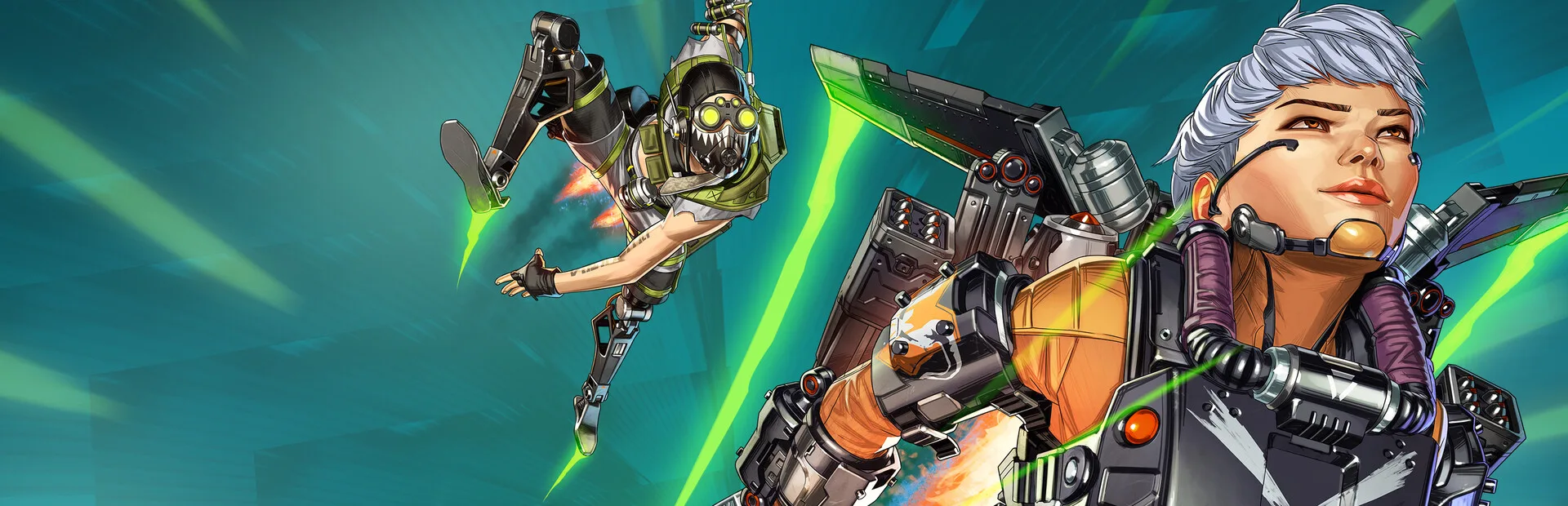
You slide down a hill in Fragment East, hit the edge of the building at the right angle, and superglide onto the roof. The Horizon who was chasing you is still on the ground floor. You armor swap the deathbox from your last kill in under a second, pop a bat behind cover, and by the time she figures out where you went, you’ve already repositioned to an angle she can’t contest. She never missed a shot. She lost because she couldn’t keep up.
That moment — a mechanical outplay with zero gunfire involved — is what Apex Legends actually is when you strip away the battle royale wrapper. Respawn built a game where movement is the primary skill expression, and everything else serves it. Seven years in, no other shooter has replicated what that feels like.

Titanfall’s Ghost in the Machine
Apex Legends exists because Titanfall 2 was too good for its own audience. Respawn’s movement system — wall-running, double jumping, slide-hopping at absurd speeds — was mechanically brilliant but alienating. Titanfall 2 sold poorly despite universal critical praise.
So Respawn dialed the philosophy back just enough. No wall-running. No double jumps for everyone. Slower base speed. But the underlying engine — Source’s air strafing, the momentum conservation through slides, the way velocity transfers between states — stayed intact. They hid Titanfall’s movement depth beneath a more approachable surface and trusted players to find it.
Players found it. Within months, the community discovered slide-jumping, bunny hopping, tap-strafing, wall bouncing, zip jumping, and a dozen other techniques that turned Apex into a movement expression game. None of these were marketed features. Most weren’t intentional. They emerged from the physics system Respawn inherited from Titanfall, and the community turned them into the core identity of the game.
This is the opposite of how most shooters handle movement. Fortnite added sliding and sprinting as discrete features. Warzone has tac-sprint as a button press. Apex’s movement is emergent — it comes from understanding how the physics engine handles momentum, and the ceiling for that understanding has no real limit.
Why Movement Beats Aim as a Skill Differentiator
Here’s the argument most shooter players don’t want to hear: aim has a hard ceiling. At the top level of any competitive shooter, everyone can aim. The difference between the 50th best Apex player and the 500th isn’t their tracking accuracy on a strafing target — it’s how they move while tracking that target.
Movement in Apex operates on a completely different axis than aim. Aim is reactive: you see a target, you track it. Movement is predictive and creative: you read the terrain, your momentum, your opponent’s position, and you chain inputs together to create an angle or escape that your opponent didn’t anticipate. A tap-strafe around a corner breaks the expected trajectory that your enemy was pre-aiming. A superglide off a ledge puts you in airspace that shouldn’t be reachable. A wall bounce off a building mid-fight changes the geometry of the engagement in a way that pure aim can’t solve.
This is why Apex has produced the most mechanically expressive highlight clips in any battle royale. When you watch someone like Aceu or Faide play, you’re not watching someone who clicks heads better than everyone else. You’re watching someone who moves through space in ways that make them functionally untargetable — and that’s a fundamentally more interesting skill to watch and learn than raw aim.
The cooldown trading layer compounds this. Every legend ability has a cooldown, and movement interacts with those cooldowns in ways that create real decision-making. Do you use Pathfinder’s grapple aggressively to take a fight-winning angle, or save it as an escape? Do you burn Wraith’s phase to reposition, knowing you’re defenseless for 25 seconds after? Movement options are cooldown resources, and the best players manage them the same way arena brawler players track their opponent’s defensive options.

The Legend System: Hero Abilities Done Right (Mostly)
Apex’s roster design follows a principle that more games should steal: abilities enable, guns decide. Your legend pick gives you a movement option, a tactical utility, and an ultimate — but none of them replace the core gunplay loop. Octane’s stim lets him move faster but costs health. Valkyrie’s jets give vertical mobility but make her a sitting duck. Every ability has a cost-benefit tradeoff that keeps the skill expression in the player’s hands rather than the character select screen.
This is the same philosophy that makes Deadlock’s hero design work — abilities as multipliers on a core combat system, not replacements for it. The difference is that Apex figured this out in 2019 and has been refining it for seven years. When the balance is right, the game feels like every legend is a different way to play the same excellent shooter. Your pick determines your movement vocabulary, not your power level.
The strongest legends follow this pattern cleanly. Pathfinder’s grapple is pure movement expression — the skill ceiling on grapple slingshots is enormous, and a good Pathfinder looks like they’re playing a different game than a bad one. Horizon’s gravity lift creates vertical angles that change fight geometry. Bangalore’s double-time passive rewards aggressive movement under fire.

The Unmatched Mid-Fight Decision Space
Where Apex separates itself from every other BR is the decision density during a fight. A typical engagement involves: reading whether to push or hold based on armor state, managing legend cooldown timing, choosing beam-or-burst based on range and cover, deciding between a shield swap and a heal based on available deathboxes, and repositioning to avoid the third party rotating toward your gunfire. All of this happens in 10-15 seconds.
The armor swap mechanic alone is a masterclass in emergent depth. Killing an opponent drops a deathbox with their armor. Swapping to it is instant — faster than any heal. This means winning a 1v1 immediately refreshes your effective HP if you can reach the box. Positioning during a fight isn’t just about cover and angles — it’s about where the body will drop and whether you can access it before the next fight starts.
Beacon rotations in ranked add another layer. Scanning survey beacons reveals the next ring location, giving a massive information advantage in a game with this much rotational freedom. Teams that play beacon properly don’t just win fights — they avoid the fights they’d lose and force the fights they’d win.
What Holds It Back
Apex has real problems, and pretending otherwise would be dishonest.
The matchmaking is the elephant in the room. Respawn has never been fully transparent about how their system works, but the community consensus — backed by data mining and analysis — is that Apex uses engagement-optimized matchmaking rather than pure skill-based matchmaking. The practical effect is that matches feel streaky: you’ll get lobbies where you dominate, followed by lobbies where you get farmed by three-stack Predator teams. The EOMM controversy has eroded trust in a way that pure gameplay quality can’t fully repair. When you lose a fight, you want to know it was fair. Apex doesn’t always give you that confidence.
Legend balance has been an ongoing struggle. The roster has grown to over 25 legends, and keeping that many kits balanced while adding new ones every season is a design challenge that Respawn has frankly not always met. There have been entire seasons where one or two legends were clearly dominant (Seer’s launch, pre-nerf Horizon, Catalyst’s wall meta), and the balance patches come slowly enough that the meta can feel stale for months.
Content drought is the more recent concern. Season launches have become less ambitious, with map updates and new legends arriving less frequently than the game’s first three years. Recycled event formats, battle passes that feel like filler, and long gaps between meaningful meta shifts all point to a team stretched thin. For a game that lives on mechanical depth, the content issue is survivable. For player retention, it’s a real risk.
The monetization compounds everything. Heirloom pricing and collection event costs are designed to extract maximum spend from invested players. It doesn’t affect gameplay, but it erodes the community-studio relationship in ways that amplify every other frustration.
The Design Lesson
Apex Legends’ core contribution to PVP game design is proof that movement systems create longer-lasting skill ceilings than any other mechanic. Aim trainers can close the gap on raw shooting skill in months. Learning to read and exploit movement across Apex’s terrain — understanding momentum, angle creation, escape routing, the interplay between legend mobility and map geometry — takes years and never fully caps out.
This is the same lesson that Naraka: Bladepoint teaches in the melee space: when your movement system is deep enough, the map itself becomes a skill-testing tool rather than just a backdrop for combat. Every building, every slope, every zip line in Apex is a movement puzzle with multiple solutions, and the player who sees more solutions wins more fights.
The studios building the next generation of competitive shooters should study Apex’s movement not as a feature to copy but as a philosophy to adopt. The games that last are the ones where players are still discovering new techniques years after launch. Apex’s community is still finding superglide variations and movement chains in 2026 — seven years after release, on an engine built for a game that came out in 2014. That’s not content. That’s not balance patches. That’s a physics system deep enough to sustain a competitive community through every drought, every bad meta, and every frustrating matchmaking streak.
How you move matters more than how you aim. Respawn proved it. The rest of the genre is still catching up.


Discussion