
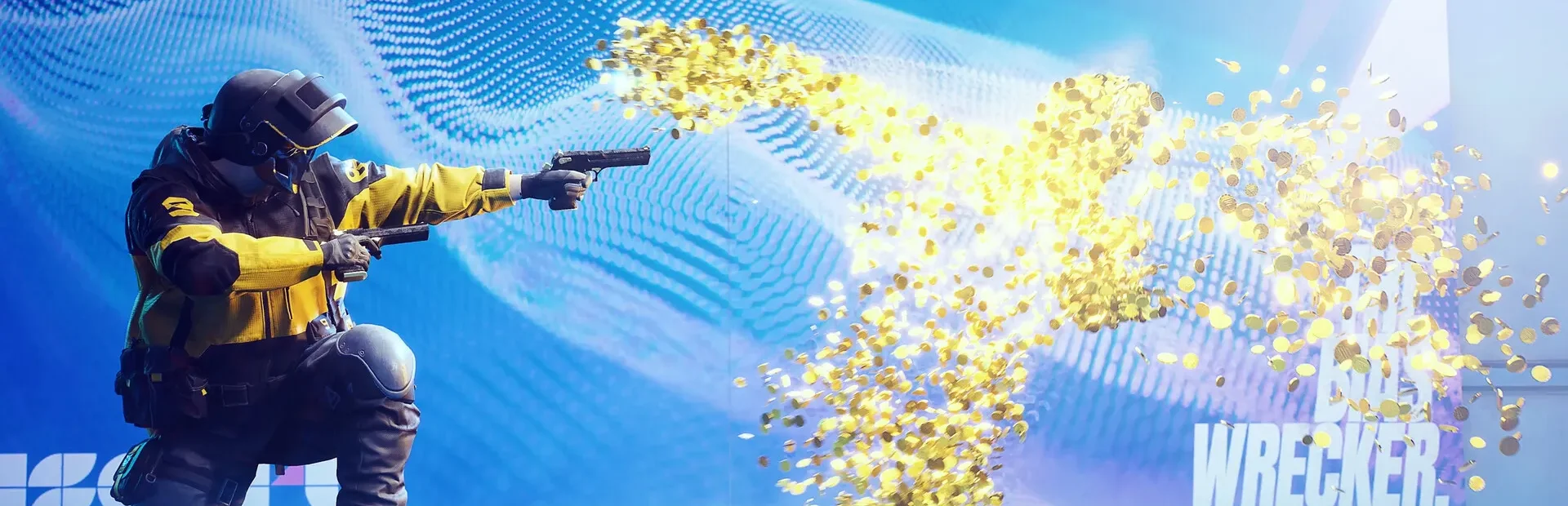
I planted C4 on the floor beneath a cashout station, dropped to the level below, and detonated it. The vault, two enemy players, and a chunk of the ceiling came crashing down on top of me. One of them died on impact. The other staggered to their feet in the rubble and I killed them with a shotgun before they could figure out which direction was up. The vault landed next to my teammate, who started the deposit while the enemy team respawned two floors away in a building that no longer had a middle floor.
That sequence was not designed. No developer placed a scripted event there. No tutorial taught me to do it. The building had a floor, I had explosives, and the game let me make a decision that most shooters would never allow. That is what The Finals gets right, and it is the single thing that keeps me coming back despite everything the game gets wrong.

Destruction as a System, Not a Gimmick
Most shooters that advertise destruction treat it as spectacle. Battlefield lets you blow up a building and it looks cool, but the rubble settles into a predetermined shape and the fight continues on functionally the same map. Rainbow Six Siege gives you destructible walls and floors, but in controlled, predictable ways that become memorized angles after a few weeks.
The Finals does something different. Nearly every surface in the game can be destroyed, deformed, or removed, and the destruction is physics-driven rather than scripted. Blow out a wall and you get an actual hole shaped by the explosion, not a pre-modeled breach point. Collapse a floor and everything on that floor — players, objects, the cashout vault itself — falls through to whatever is below. Chain enough destruction together and entire buildings become skeletal frameworks of support beams and dangling rebar.
This matters for competitive play because it means the map is never the same twice. In Counter-Strike, you learn that you can smoke off A long and flash over the top of the box at a specific angle. That knowledge is permanent. In The Finals, the box might not exist anymore. The wall you were going to peek from might have been RPG’d thirty seconds ago. The floor you planned to hold might have a hole in it from the team that fought here before you arrived.
Map knowledge in The Finals is not about memorizing sightlines. It is about understanding structures — which walls are load-bearing, which floors can be collapsed to create vertical plays, which ceilings are thin enough to breach with a single charge. This is a fundamentally different kind of spatial awareness, and it rewards creative thinking over rote memorization.
Three Classes, Three Relationships to Destruction
The class system in The Finals is deceptively simple. Light, Medium, Heavy. Small, normal, big. But each class has a completely different relationship to the destruction system, and that is where the real depth lives.
Heavy is the architect of chaos. The RPG-7, C4, and Sledgehammer are tools for reshaping the battlefield. A good Heavy player does not just fight enemies — they fight the building. They blow open flanks that did not exist. They collapse floors to deny defensive positions. They create sightlines for their team by removing walls. The skill expression is not just aim; it is spatial problem-solving under pressure. When you watch a high-level Heavy player, they are making decisions about the geometry of the fight before they make decisions about the gunfight itself.
Medium is the generalist who adapts to whatever geometry exists. Healing Beam, Defibrillator, Jump Pad — Medium’s gadgets are about exploiting the space that Heavy creates or that destruction has left behind. The Defibrillator is arguably the single most important gadget in competitive play, because in a game where fights are fast and positions shift constantly, the ability to bring back a dead teammate on the spot changes the math of every engagement. A team that wins a 3v3 but loses one player is in a worse position than a team that loses but has a Medium who can revive in the rubble.
Light is the opportunist. Cloaking Device, Grapple Hook, Stun Gun — Light thrives in the chaos that destruction creates. Every new hole in a wall is a new flank route. Every collapsed floor is a vertical angle nobody is watching. Light players read the destruction state of the map like a language, finding paths through the wreckage that heavier classes cannot fit through or reach. The skill ceiling is enormous because the available plays change every time something blows up.
This three-way dynamic means team composition is not just about having the right abilities — it is about having the right relationship to destruction. Three Lights have mobility but cannot reshape the map. Three Heavies can demolish everything but lack the speed to capitalize. The meta revolves around how these classes interact with a constantly changing environment, and that is genuinely novel.

The Game Show That Somehow Works
The Finals wraps its competitive shooter in a game show format, and against all odds, it works. Announcers commentate on your plays. The aesthetic is flashy and unapologetically arcade. This solves a problem most PVP games struggle with: it gives the chaos a reason to exist. In a military shooter, buildings collapsing around you creates tonal dissonance. In The Finals, the destruction is the entertainment. Blow the floor out from under someone and the announcer loses their mind. It is permission to play creatively, baked into the fiction.
The cashout game mode ties it together. Teams steal vaults, carry them to deposit locations, and defend while the money counts up. The vaults are physical objects that interact with destruction — they fall through holes, get buried in rubble, roll down slopes. A team holding a cashout on the second floor is making a bet that the floor will still exist in sixty seconds. Often, it will not.
This creates a natural escalation. Early in the round, buildings are intact and fights are conventional. By the final cashout, the map is skeletal. Teams are fighting in the remains of structures, improvising cover from debris. The game gets wilder as the stakes get higher, and that is a brilliant arc for a competitive match.
Fresh Air in a Stale Room
The competitive FPS space has a staleness problem. Valorant is Counter-Strike with abilities. The next hero shooter is the last hero shooter with a different IP. Battle royales have been iterating on the same formula since 2017.
The Finals sidesteps this entirely. There is no other shooter where you RPG the floor out from under a team and steal their objective as it falls through the hole. No other game where a goo grenade seals a doorway, creating a temporary wall that buys you ten seconds to deposit. No other competitive FPS where the map at the end of the match bears almost no resemblance to the map at the start.
Like Deadlock, The Finals succeeds because it is willing to be genuinely different rather than iterating safely on what already exists. Both games asked “what if we added a system that fundamentally changes how the genre plays?” and committed fully to the answer. The MOBA layer in Deadlock and the destruction layer in The Finals are not features — they are the game.
And like the cooldown trading that defines arena brawlers, The Finals has its own resource economy that separates good players from great ones. Gadgets are on cooldowns. Destruction is permanent within a round. Every C4 charge, every RPG rocket, every goo grenade is a decision about how to reshape the battlefield. Great players do not just use these tools to kill enemies — they use them to create advantages that compound over the course of a match. Blowing a wall open is not just about the kill you get now; it is about the sightline that exists for the rest of the round.
What Embark Gets Wrong
The Finals is not a perfect game, and some of its problems are serious enough to threaten its long-term health.
Balance swings are violent. Embark patches aggressively, and the meta shifts dramatically with each update. Weapons and gadgets go from dominant to useless and back again on a seasonal basis. The Throwing Knives were oppressive, then gutted, then reworked. The RPG-7 has been nerfed and buffed multiple times. This keeps the game feeling fresh for some players, but it erodes trust for competitive players who invest time mastering a loadout only to have it fundamentally changed. Consistent balance philosophy matters more than constant balance changes.
Monetization is a sore point. The battle pass and store are aggressive. Pricing is high for cosmetics. The game launched free-to-play, which is the right call for population, but the cosmetic economy feels designed to extract rather than reward. For a game that relies on its community staying engaged, this creates friction that is entirely self-inflicted.
Ranked population is thin. This is the big one. The Finals has a healthy casual player base, but the ranked queue — especially at higher tiers — suffers from the same population problems that plague every mid-tier competitive game. Queue times stretch. Skill gaps widen. Players who want to take the game seriously find themselves in lobbies that feel inconsistent. As the matchmaking article on this site explores, this is a structural problem that no amount of good game design can fully solve when the population is not large enough to support tight skill brackets at all hours.
Content cadence is uneven. Seasons bring new maps and gadgets, but the pace has slowed from the game’s explosive launch period. The destruction system means new maps require significantly more engineering work than a traditional shooter map, which partly explains the slower output. But players do not grade on a curve. They compare update frequency to Fortnite, Valorant, and Apex, and The Finals comes up short.

The Design Lesson
The Finals proves something that the best PVP games of 2026 all share in common: the games that endure are the ones built around a single system so deep that it generates infinite variation. Counter-Strike has its economy. Hunt has its sound design and permadeath stakes. Battlerite had its cooldown trading. The Finals has destruction.
When your core system is strong enough, every match tells a different story. Not because the developers scripted different scenarios, but because the players created them. The floor collapse play I described at the top of this article has happened to me once in hundreds of hours. Not because it is rare, but because the specific combination of building layout, vault position, enemy positioning, and available explosives will never line up exactly the same way again.
That is what emergent gameplay means in practice. Not a buzzword on a Steam page. The game gives you a physics system, a set of tools, and a destructible world, and then gets out of the way. The best moments in The Finals are moments Embark never designed and could never have predicted. They built the sandbox and let the contestants loose.
The competitive FPS genre does not need another game with three lanes, five players, and a defuse objective. It needs more games willing to bet on a single ambitious system and build everything around it. The Finals made that bet on destruction, and even with all its problems, the bet paid off.
The floor is a weapon. The walls are temporary. The ceiling is a suggestion. No other shooter plays like this, and that alone makes The Finals worth your time.

Discussion