
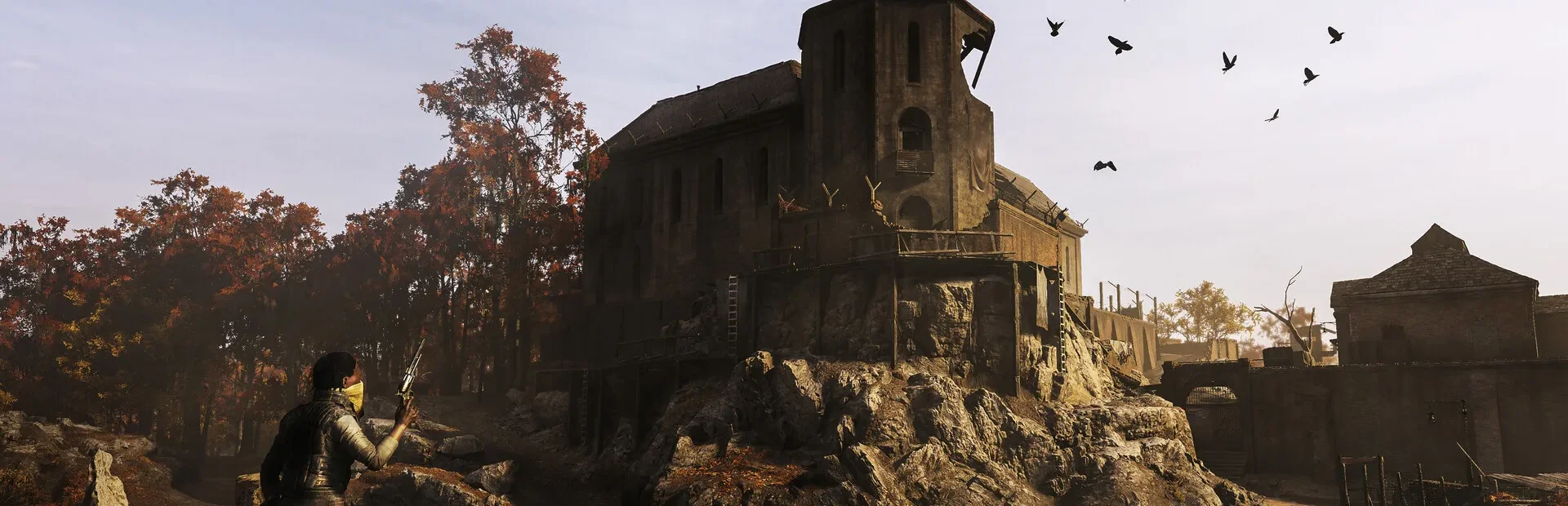
I have never been more afraid in a PVP game than the first time I heard footsteps on a wooden floor in Hunt: Showdown. Not scripted horror footsteps. Real ones. Another player, somewhere in the building above me, who had heard me first and was already repositioning. My hunter had three hours of progression on him. Good weapons. Good perks. One life.
I crouched in the dark and held my breath. The real one, not the in-game one.
That moment is what Hunt: Showdown does better than any other competitive game. It makes the space between fights more intense than the fights themselves. It builds tension through systems, not scripting — through the constant understanding that everything you’ve earned is one gunfight away from being gone forever.
The Bounty Hunt Loop
Hunt’s core mode, Bounty Hunt, is a masterclass in designing PVP encounters that feel organic rather than manufactured.
Here’s the setup: up to twelve players (solo or in duos/trios) load into a match on one of Hunt’s maps — sprawling, atmospheric recreations of Louisiana bayou in the late 1800s. Scattered across the map are clues that lead you to a boss lair. You find the clues, locate the boss, kill the boss, pick up the bounty token, and extract with it at one of several exit points on the map’s edge.

The genius is what this structure creates. Every other team on the server is following the same clue trail. You’re converging on the same locations. But you don’t know exactly when or from which direction. The boss lair becomes a natural focal point for PVP — not because the game puts you in a queue and counts down from three, but because the objective draws everyone together organically.
And then the extraction. Once you pick up the bounty, every remaining player on the server can see your approximate location. You become the target. The walk — sometimes run — to the extraction point with that bounty in your hands is some of the most nerve-wracking PVP in any game. Every bush could be a player with a Mosin-Nagant. Every compound you pass through could be an ambush. Do you take the closest extract and risk the obvious route, or do you go to the far one and risk a longer exposure time?
This is PVP design that respects the player’s intelligence. The game gives you information, creates competing incentives, and lets the tension emerge from your own decision-making. No other shooter gives you this many meaningful choices per minute.
Sound Design as Gameplay
Most games use sound for atmosphere. Hunt: Showdown uses sound as a core gameplay system, and it’s the single most important reason the game feels the way it does.
The map is littered with sound traps. Crows that scatter and caw when you walk near them. Horses that whinny and stomp. Broken glass on floors. Chains hanging in doorways. Kennels full of hellhounds that bark when disturbed. Water that splashes when you wade through it. Each one broadcasts your position to anyone within earshot.
This means movement itself is a skill. An experienced Hunt player doesn’t just move from A to B. They route around sound traps, crouch through compounds, time their sprints to windows where they’re confident nobody is listening. A new player sprints through a flock of crows, and every team within 150 meters knows exactly where they are.
The result is a meta-game built entirely around audio. You learn to listen before you look. You identify the direction and distance of a gunshot. You hear crows scatter across the map and know a team just passed through that treeline. You hear nothing at all — which might mean you’re alone, or might mean another player is crouched twenty meters away, being very, very quiet.
This is what makes Hunt’s cooldown trading unique. In an arena brawler, you’re tracking abilities. In Hunt, you’re trading information. Every shot you fire tells the entire server where you are. A suppressed weapon costs you damage for silence. A shotgun is devastating up close but announces your building to everyone. The economy isn’t cooldowns — it’s noise.
The Stakes
Here’s where Hunt diverges from every other shooter and enters territory that most PVP games are afraid to touch: when your hunter dies, they’re gone. Their weapons, their perks, their traits — all of it, deleted. You recruit a new hunter and start over.
This sounds punishing. It is punishing. And it’s the entire point.
Permadeath changes the psychology of every decision. In Call of Duty, you push a corner aggressively because if you die, you respawn in five seconds. In Hunt, you hold that corner for thirty seconds, listening, because pushing and being wrong costs you hours of progression. The fear of loss creates caution, and caution creates tension.
But Hunt doesn’t make dying trivial to avoid. The bounty system forces you into danger. You can’t just camp the edges of the map — the boss lairs are where the action converges, and the bounty extraction demands that you move through exposed territory. The game constantly puts your earned progression at risk, and that risk is what makes the rewards feel meaningful.
When you survive a server wipe — killing multiple teams and extracting with the bounty — the high is unreal. Not because the game gave you a “Victory Royale” screen, but because you earned that extraction against real players who wanted to take everything from you. When you lose a hunter you’ve had for twenty matches to a headshot you never saw coming, it stings in a way that no other PVP game achieves. Both feelings keep you playing.
The progression system amplifies this. Your hunter earns traits through gameplay — faster movement, quieter footsteps, better aim stability. A high-level hunter with carefully chosen traits plays meaningfully different from a fresh recruit. Losing that hunter doesn’t just cost money; it costs capability. This is what makes the risk/reward calculation so visceral. You’re not just risking in-game currency. You’re risking a character you’ve shaped.
Why It Works as PVP Design
Hunt: Showdown understands something fundamental that most PVP games ignore: tension requires something to lose.
In a standard deathmatch shooter, the emotional range is narrow. You win, you feel good. You lose, you queue again. The stakes are your time and your ranking number. In Hunt, the emotional range is enormous. Relief, dread, exhilaration, paranoia — sometimes all in the same compound clear. You feel this range because there is genuine consequence to the outcome.
This applies beyond Hunt. The reason For Honor duels feel tense is because each round matters in a first-to-three. The reason ranked matches in any game feel different from casual ones is because your visible rating is on the line. The thing that separates “playing a game” from “competing” is stakes — and Hunt has the highest stakes in the shooter genre.
The extraction moment crystallizes this. You’ve killed the boss. You have the bounty. You can see teams converging on the compound. Do you fight for the second bounty or leave with what you have? Do you take the nearby extract that everyone can predict, or the far one that gives enemies more time to intercept? This decision — fight or flee, greed or safety — is the core tension of every great PVP game, compressed into a single, high-stakes moment.
It’s also worth noting how Hunt handles matchmaking. The game uses a star-based skill rating and attempts to fill servers with similarly rated players. When it can’t — which happens at off-peak hours given the game’s moderate population — you’ll sometimes face teams well above your bracket. These matches feel unfair, and they are. But Hunt’s design partially compensates: a well-placed headshot from a cheap Winfield kills just as dead as one from an expensive Mosin. Mechanical skill and positioning can overcome loadout and progression advantages in ways that few games with persistent progression allow.
What It Gets Wrong
Hunt is not a game for everyone, and some of its problems are real, not just difficulty barriers.
The learning curve is brutal. Your first twenty hours will be spent dying to things you don’t understand — players you never saw, sound cues you didn’t recognize, AI enemies that feel unfair until you learn their patterns. The game does very little to teach you its systems. You learn by dying, over and over. This is fine for players who enjoy mastery-driven games. It’s a hard sell for everyone else.
Performance is inconsistent. Even after the engine upgrade to CryEngine 5.11, Hunt runs poorly on mid-range hardware compared to other shooters. Frame drops during fights in dense compounds are common. For a game where a single missed frame can mean a missed headshot, this is a real competitive issue.
Monetization is aggressive. Crytek has pushed hard on premium skins and DLC hunters. While none of it is pay-to-win in the traditional sense, some premium skins have been called out by the community for having smaller visual profiles, which creates a subtle advantage. For a game built on visual information — spotting an enemy’s silhouette against the treeline — this matters more than it would in other games.
The population is fragile. Hunt lives in the mid-tier of player counts. Enough to sustain matchmaking during peak hours, but thin enough that off-peak matches can feel empty or wildly imbalanced. The extraction shooter genre has grown more crowded, and every new competitor — Escape from Tarkov, Dark and Darker, Gray Zone Warfare — pulls from a finite pool of players who enjoy high-stakes PVP.
The Lesson for PVP
Hunt: Showdown’s design thesis is simple and powerful: if you want players to feel something when they win, you have to make them feel something when they lose.
Most competitive games are moving in the opposite direction. Shorter matches. Faster respawns. Reduced penalties for losing. The logic makes sense from a retention standpoint — players who feel bad stop playing. But Hunt proves that the opposite can also be true. Players who feel the stakes play with an intensity and focus that no-penalty games can’t replicate.
This doesn’t mean every PVP game needs permadeath. But every PVP game needs stakes of some kind. The visible rating in CS2’s Premier mode. The round-based elimination in Battlerite. The Drive Gauge burnout risk in Street Fighter 6. The games that make players invest something — whether it’s a character, a rating, or a resource — in the outcome of a fight are the games that produce the most memorable PVP moments.
Hunt: Showdown built an entire game around that principle. Walk through the bayou with a bounty in your hands, two bullets left in your Sparks, and the sound of crows scattering behind you. Tell me your heart rate doesn’t spike.
That’s what good PVP design feels like.

Discussion