
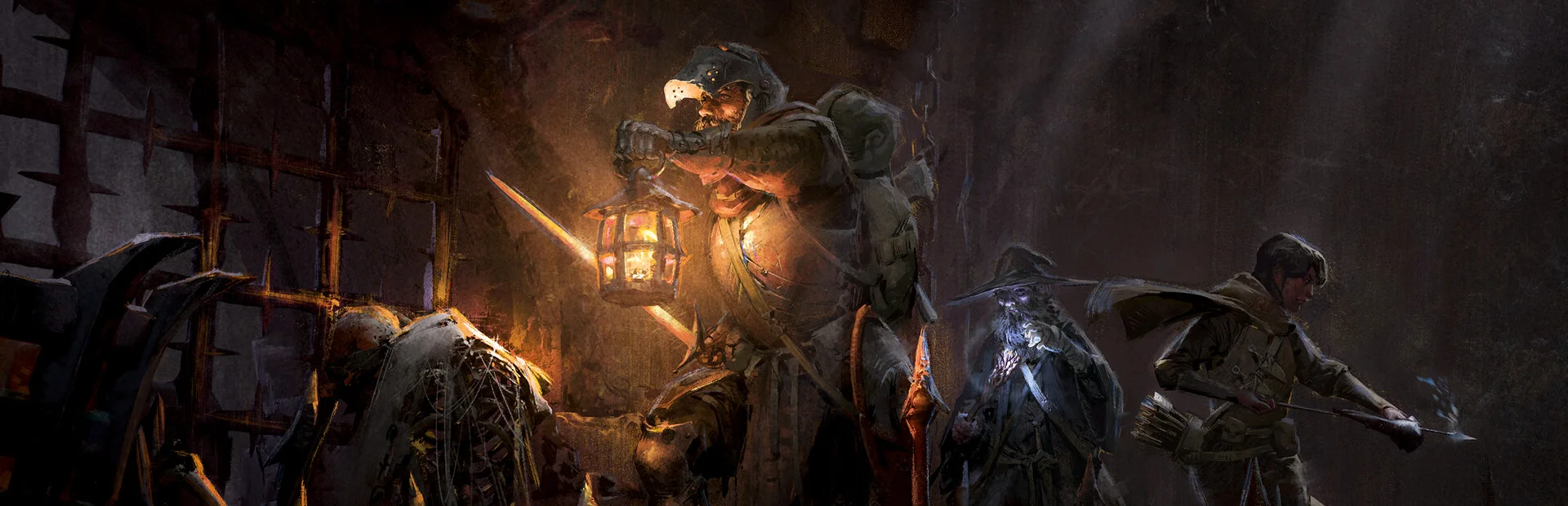
You’re three rooms deep into a dungeon when you hear it. Footsteps. Not the shuffling of skeletons or the heavy thuds of a cave troll — those you’ve learned to filter out. These are deliberate. Player footsteps. Someone is on the other side of that door, and they’ve probably heard you too.
In that moment, Dark and Darker becomes something no other extraction game has managed. It’s not a tactical shooter where you’re checking corners. It’s not a battle royale where you’re looting for the final circle. It’s a dungeon crawl where another adventuring party just walked into your corridor, and neither of you knows who’s going to make it out alive.
The Fantasy Extraction Formula
The pitch sounds like a joke someone told at a game jam: “What if Escape from Tarkov, but medieval fantasy? With DnD classes?” Ironmace wasn’t joking, and the result is one of the most original PVP experiences in years.
Dark and Darker drops parties of up to three players into procedurally arranged dungeon maps filled with PVE enemies, loot, and other player teams. You kill monsters, open chests, find gear, and search for extraction portals to escape with your haul. If you die, you lose everything you brought in. Your character’s equipped loadout, your potions, your hard-earned loot — all gone.
The class system is what elevates this beyond a medieval Tarkov skin. Fighter, Barbarian, Rogue, Ranger, Wizard, Cleric, Bard, Warlock — each plays fundamentally differently, not just in combat but in how you navigate the dungeon. A Rogue can stealth past encounters that a Barbarian would have to fight through. A Cleric sustains a trio through punishing PVE rooms that would drain a DPS-only squad. A Wizard controls space with spells that reshape entire corridors.
This means every player encounter isn’t just “who shoots first.” It’s a tactical puzzle shaped by class composition, positioning, available resources, and whether you’re willing to risk the loot you’ve already collected. That layering of decisions is what makes Dark and Darker’s PVP feel like an adventure rather than a deathmatch.
Why First-Person Melee Works Here
Most first-person melee games feel terrible. The genre has a long history of clunky sword-swinging where you can’t tell if you’re hitting anything. Dark and Darker doesn’t fully solve this — let’s be honest about that — but it does something clever: it makes the clunkiness part of the design language.
Attacks have real commitment. A Barbarian’s two-handed axe swing takes time to wind up, time to recover from, and leaves you exposed. A Fighter’s sword is faster but reaches shorter. A Rogue’s daggers are quick but require you to get dangerously close. Every weapon class has genuine trade-offs in speed, range, and recovery, and those trade-offs create something approaching real dueling depth.
This is different from what For Honor does with its directional guard system — that game built an entire combat language around reads and reactions. Dark and Darker’s melee is simpler in its core inputs but gains complexity from the dungeon environment. Narrow corridors favor different weapons than open rooms. Doorways become chokepoints you can hold with a shield or a well-placed spell. Verticality from staircases and elevated platforms gives archers and casters genuine positional advantages.
The result is that fights feel scrappy and desperate in a way that complements the dungeon fantasy. You’re not executing practiced combos. You’re swinging a torch in one hand and a longsword in the other while a Wizard fires magic missiles over your shoulder at the Rogue trying to flank your Cleric. It’s messy, high-stakes, and thrilling in a way that polished combat systems often aren’t.
The Loot Stakes
This is the part that makes Dark and Darker’s PVP actually matter, and it’s the same design principle that makes Tarkov compelling: loss aversion is the most powerful motivator in gaming.
When you load into a dungeon wearing your best gear — a blue-rarity longsword you found three runs ago, a chestplate with perfect rolls, a stack of healing potions you’ve been saving — every decision carries weight. Do you push deeper toward the higher-tier loot rooms where better-geared players are likely farming? Do you play it safe, grab what you can from the outer rooms, and extract early? Do you engage that team you just heard, risking your loadout for theirs?
These are genuine strategic decisions, not just moment-to-moment reactions. And they create a cooldown-trading dynamic at a macro level — you’re trading risk against reward across entire runs, not just ability cycles. A team that just finished a tough PVE encounter has burned potions and abilities. If you catch them in that window, you have a massive advantage. But they might have the best loot in their bags, making the fight worth it. The calculation is constant.
The gear progression loop ties it together. Better gear makes PVE easier and PVP more survivable, but it also raises the stakes of every run. A naked player with a basic sword has nothing to lose and everything to gain. A geared player has everything to lose. That asymmetry creates encounters where both sides have entirely different motivations, and that unpredictability is what keeps the extraction loop from going stale.
The Solo vs Squad Dynamic
Dark and Darker transforms based on party size, and this is something it handles better than most extraction games.
Solo play is pure survival horror. Every sound could be a player. Every room is a gamble. You pick your engagements carefully because any fight could end your run. The Rogue class shines here — stealth lets you scout ahead, pick off isolated targets, and vanish before their teammates arrive. Solo play rewards patience, map knowledge, and knowing when to walk away from a fight you could technically win but probably shouldn’t.
Trio play is a completely different game. It’s coordinated dungeon crawling — your Cleric keeps the group topped off through PVE, your Fighter holds doorways while your Ranger picks off approaching enemies, and your team communicates about when to push and when to extract. Team fights against other trios are chaotic, positioning-heavy brawls where focus fire and ability coordination separate good teams from great ones.

The fact that solos and trios can end up in the same dungeon is controversial, but I think it’s correct. A solo player who outplays a trio and steals their loot is one of the most exhilarating moments in PVP gaming. And a trio that gets picked apart by a patient solo player learns that numbers don’t guarantee safety. The asymmetry creates stories — and stories are what keep players coming back to extraction games.
What Ironmace Gets Wrong
Dark and Darker is not a polished game. It’s important to say this plainly because the enthusiastic community sometimes papers over real problems.
Performance is rough. Frame drops in busy areas, server desync that makes melee registration inconsistent, rubber-banding during intense fights. For a game where the difference between a hit and a miss is often life or death, the netcode needs to be better. This isn’t the kind of thing you can handwave with “it’s early access” when people are investing real time into gear they can lose permanently.
Class balance is a moving target. Wizard has oscillated between useless and oppressive across patches. Barbarian’s raw HP pool makes early-game PVP feel coin-flippy against less-geared players. Bard’s utility-focused design means they’re incredibly strong in organized trios but feel pointless solo. Ironmace patches frequently, which is good, but the swings are sometimes dramatic enough to invalidate entire playstyles overnight.
The legal drama with Nexon — accusations of stolen assets, lawsuits, countersuits — created a cloud over the game that still lingers. Whether or not you think the accusations had merit, the controversy made some players hesitant to invest in a game whose future felt uncertain. Ironmace has continued development and the game is clearly thriving, but the drama cost them momentum during a critical growth period.
The new player experience is punishing. You load in, die to skeletons because you don’t understand the PVE, and lose your starter gear. Or you survive the PVE and get instantly killed by a geared player. The game doesn’t teach you how extraction works, what the risk/reward calculation should be, or even basic combat mechanics. This is the same problem that keeps Tarkov’s audience smaller than its design deserves — matchmaking and onboarding matter, and extraction games consistently undervalue both.
The Lesson for PVPvE Design
Here’s what Dark and Darker proves that most PVPvE games get wrong: the PVE has to be genuinely engaging on its own, or the PVP has no foundation.
In games where the PVE is just a warmup — clear some bots, get some loot, then the “real game” starts when you fight players — the extraction loop gets stale quickly. The PVE becomes a chore you endure to access the PVP. Dark and Darker avoids this because the dungeon crawling is actually fun. The PVE enemies have real threat patterns. The dungeon layouts create genuine exploration. The loot system rewards thorough clearing. The class-based party composition makes PVE encounters tactically interesting.
When a player encounter happens on top of that engaged PVE experience, it’s not interrupting a warmup — it’s escalating an adventure. You’re already invested. You’re already making decisions. The PVP raises the stakes of decisions you’re already making, rather than replacing them with a different game entirely.
This is the same insight that made the best PVP games of 2026 compelling: the games that last are the ones where every moment matters, not just the final confrontation. Dark and Darker understood that extraction PVP needs a world worth exploring before it needs enemies worth fighting. Build the dungeon first. The player encounters take care of themselves.
Ironmace built something genuinely special — rough edges and all. In a space dominated by military extraction shooters, they proved that the formula works in fantasy, that class-based PVPvE creates richer encounters than loadout-based systems, and that sometimes the best PVP moments happen when you weren’t looking for a fight at all. You were just trying to make it out of the dungeon alive.


Discussion