
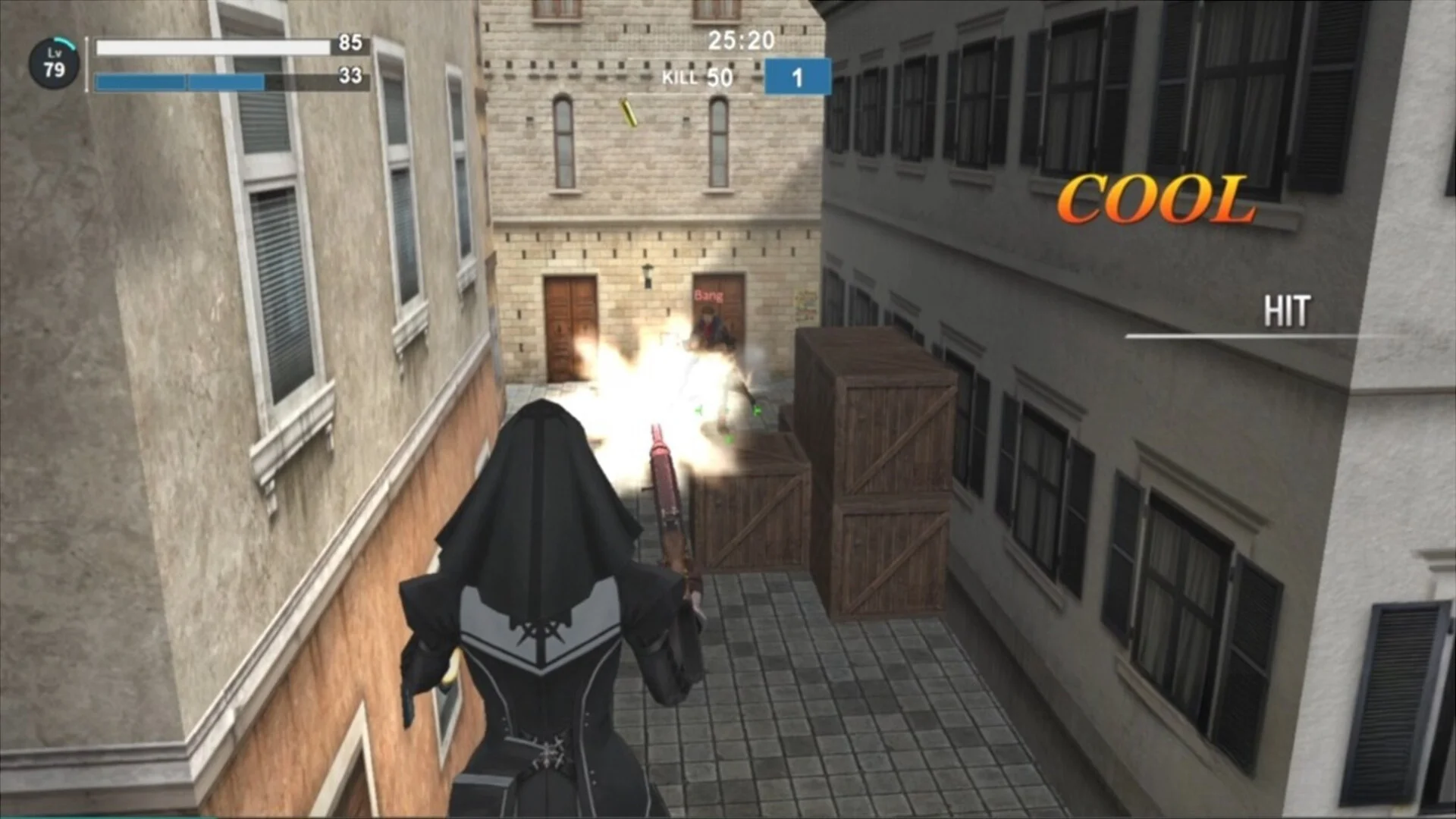
If you know, you know. If you don’t, you’re about to learn about the most mechanically demanding PVP game ever created — and it was an accident.
GunZ: The Duel launched in 2003 from Korean developer MAIET Entertainment. It was designed as a stylish third-person shooter inspired by Hong Kong action films — wall-running, dual-wielding, sword slashing, all at breakneck speed. What the developers didn’t plan for was the community discovering a system of animation cancels so deep and so precise that it turned GunZ into something no one had ever seen before.
They called it K-Style. And nothing in gaming has ever matched its mechanical ceiling.
For fans of games that push mechanical skill to the limit, GunZ sits in the same spiritual lineage as Bloodline Champions and Battlerite — games where the skill ceiling was the point.
How GunZ Works (The Basics)
GunZ is a third-person shooter with melee combat, wall-running, and weapon switching. The core systems are straightforward on the surface — it’s what players did with them that became extraordinary.
Movement System
| Action | Input | Description |
|---|---|---|
| Walk | WASD | Standard directional movement. Slow. You should never be walking in combat. |
| Dash | Direction + Jump | Quick burst of directional movement. Brief invulnerability frames during startup. Core of all K-Style movement. |
| Wall Run | Jump at wall | Run along vertical surfaces. Can attack during wall run. Jumping off a wall gives height. |
| Wall Jump | Jump during wall run | Launch off a wall for vertical mobility. Chain wall jumps for height and repositioning. |
| Tumble | Crouch + Direction | Ground roll for low-profile evasion. Brief invulnerability. Slower than dash but lower profile. |
| Massive | Jump + Crouch + Swing | Leap attack that launches you forward with a sword swing. Key transitional move in K-Style chains. |
Combat System
GunZ has three weapon slots plus a melee weapon:
| Slot | Weapon Types | Role |
|---|---|---|
| Melee |  Sword, Sword,  Kodachis, Dagger Kodachis, Dagger | Close-range damage. The foundation of K-Style. Every character carries a melee weapon. |
| Primary |  Shotgun, Shotgun,  SMG, Rifle, SMG, Rifle,  Revolver, Revolver,  Rocket Launcher Rocket Launcher | Main ranged weapon. Shotgun is the K-Style standard for slash shot combos. |
| Secondary |  Pistol, SMG, Revolver Pistol, SMG, Revolver | Backup ranged weapon. Often a revolver for mid-range poke. |
| Item Slots | Medkits, Grenades, Flash Grenades, Smoke | Utility. Medkits are essential. Grenades for area denial. |
Every weapon has startup frames, active frames, and recovery frames. Recovery frames are the vulnerability window after an attack — you can’t block, can’t attack, can’t move at full speed. This is where K-Style enters the picture.
The Animation Cancel Principle
Key Concept: Every action in GunZ has a recovery animation. K-Style is the systematic exploitation of those recovery windows by chaining specific inputs that cancel recovery frames, enabling continuous attack chains with no downtime. The game was not designed for this. The community invented it.
In GunZ, certain actions cancel the recovery of other actions:
- Block cancels sword swing recovery
- Dash cancels block recovery
- Weapon switch cancels various recoveries
- Sword swing cancels dash recovery
Chain these correctly: Swing → Block → Dash → Swing → Block → Dash… and you get a perpetual loop of attacks with no recovery frames. This is the butterfly — the foundation of K-Style.
K-Style: The Core Techniques
K-Style (Korean Style) is the name for the entire system of animation canceling that transformed GunZ from a third-person shooter into a melee-focused skill game. What follows is every major technique, from foundational to frame-perfect.
Butterfly (BF)
The foundation. If you can’t butterfly, you can’t play K-Style.
Key Concept: The butterfly is a repeating cancel loop — slash, block-cancel, dash, slash, block-cancel, dash — that makes your character fly through the air while continuously swinging a sword. It’s faster than normal movement and deals damage the entire time. A perfect butterfly looks like the game is broken. It’s not. It’s just being played at a level the developers never imagined.
Input sequence (one cycle):
| Step | Input | What Happens | Timing Window |
|---|---|---|---|
| 1 | LMB (Sword) | Sword slash — damage frame | — |
| 2 | RMB (Block) | Block cancels slash recovery | 2-4 frames after slash connects |
| 3 | Direction + Jump | Dash cancels block recovery | 1-3 frames after block |
| 4 | LMB (Sword) | Next slash starts during dash | 2-4 frames into dash |
| 5 | Repeat from step 2 | Loop continues indefinitely | — |
Frame timing: At GunZ’s 60fps, each cancel window is 33-66 milliseconds. The full cycle runs roughly 3 times per second. Missing a window by 2-3 frames breaks the chain and leaves you in recovery — vulnerable.
What it looks like: Your character flings through the air in a spinning, slashing whirlwind, changing direction with each dash. To an untrained eye, it looks like a glitch. To a GunZ player, it looks like someone who’s spent 2,000+ hours practicing.
Directional control: Each dash in the butterfly can be aimed in any direction. Expert butterfliers constantly adjust direction mid-chain to track moving targets, evade return fire, and control spacing.
Common mistakes:
- Block too early → slash doesn’t complete, no damage
- Block too late → eating recovery frames, slower than walking
- Dash direction wrong → flying past the target instead of staying in range
- Panic mashing → inputs overlap, chain breaks
Practice method: Start against a wall in an empty room. Slash, block, dash INTO the wall (so you don’t fly away), repeat. Get the rhythm consistent before trying it in open space.
Half-Step (HS)
Butterfly’s grounded cousin. Your close-range melee tool.
| Step | Input | What Happens | Timing Window |
|---|---|---|---|
| 1 | LMB (Sword) | Sword slash | — |
| 2 | RMB (Block) | Block cancels slash recovery | 2-4 frames |
| 3 | Tap direction | Small step (not a full dash) | 1-3 frames |
| 4 | LMB (Sword) | Next slash | 2-4 frames |
| 5 | Repeat from step 2 | — | — |
Why it matters: Half-step is faster than butterfly for short-range damage because you’re not dashing away from the target each cycle. When you’re already in someone’s face — after landing a butterfly approach or catching someone in a corner — half-step maximizes your DPS.
Directional variants:
- Forward HS: Step toward the target. Aggressive, maximizes contact time.
- Side HS: Step laterally. Harder to track for the opponent, but risk of stepping out of range.
- Backward HS: Step away slightly each cycle. Defensive, creates space while still dealing damage.
Slash Shot (SS)
The bread-and-butter ranged-melee hybrid. This is where K-Style gets truly lethal.
Key Concept: Slash shot fires your gun during the sword slash cancel window, dealing both melee AND ranged damage in a single combo cycle. It effectively doubles your damage output compared to pure butterfly and lets you kill at ranges where sword-only play can’t reach.
Input sequence:
| Step | Input | What Happens | Timing Window |
|---|---|---|---|
| 1 | LMB (Sword) | Sword slash | — |
| 2 | Weapon switch (1 or 2) | Switch to gun, canceling slash recovery | 2-3 frames |
| 3 | LMB (Gun) | Fire gun (typically shotgun) | Immediate |
| 4 | Weapon switch (3) | Switch back to sword | 1-2 frames after shot |
| 5 | RMB (Block) | Block cancels switch recovery | 2-3 frames |
| 6 | Direction + Jump | Dash cancels block | 1-3 frames |
| 7 | Repeat from step 1 | — | — |
Why shotgun: Shotgun is the K-Style standard because it deals maximum damage in a single shot (no need to spray), and the weapon switch cancel eliminates its pump-action recovery entirely. A slash shot cycle with shotgun deals sword damage + full shotgun blast every ~0.4 seconds.
Revolver variant: Some players use revolver instead of shotgun for longer range. Less burst per cycle but effective at mid-range where shotgun spread reduces damage.
Slash shot vs pure butterfly DPS:
- Pure butterfly: ~3 sword hits per second
- Slash shot: ~2.5 sword hits + ~2.5 shotgun blasts per second
- Effective DPS difference: slash shot deals roughly 2.5x the damage of pure butterfly
This is why every competitive K-Style player uses slash shot. Pure melee butterfly is a stepping stone — slash shot is the real game.
Double Butterfly (DBF)
Advanced technique. Two slashes per cycle.
| Step | Input | What Happens | Timing Window |
|---|---|---|---|
| 1 | LMB (Sword) | First slash | — |
| 2 | LMB (Sword) | Second slash (rapid input) | 1-2 frames after first slash |
| 3 | RMB (Block) | Block cancels second slash recovery | 2-3 frames |
| 4 | Direction + Jump | Dash cancels block | 1-3 frames |
| 5 | Repeat from step 1 | — | — |
Why it matters: DBF deals double sword damage per butterfly cycle. Against a player using single butterfly, you will win every melee trade. The timing window for the second slash input is ~1-2 frames (16-33ms) — narrow enough that it requires dedicated practice.
Common failure mode: Inputting the second slash too early cancels the first slash (no damage). Too late and the block window passes. The sweet spot is frame-perfect, and it’s different for each sword type.
Practice note: DBF is the mechanical threshold between intermediate and advanced K-Style. Most players who claim to DBF consistently are actually hitting it 60-70% of the time — the ones who hit it 90%+ are the top tier.
Triple Butterfly (TBF)
Near-frame-perfect execution. The theoretical DPS maximum of melee K-Style.
Three slashes per cycle. The timing is so precise that only a handful of players in GunZ history could execute it consistently in live matches. Most players who claimed TBF were doing DBF with lucky extra inputs.
Input timing: Each additional slash requires a ~16ms window (1 frame at 60fps). Three slashes require hitting two consecutive 1-frame windows perfectly. The probability of hitting both windows randomly is effectively zero — TBF requires deliberate muscle memory.
DPS comparison:
| Technique | Slashes/Cycle | Relative DPS |
|---|---|---|
| Single BF | 1 | 1.0x |
| Double BF | 2 | ~1.8x |
| Triple BF | 3 | ~2.5x |
| TBF + Slash Shot | 3 + shotgun | ~4.0x |
TBF with slash shot represents the theoretical maximum damage output in GunZ. No human can sustain it perfectly for more than a few cycles — but even hitting it intermittently during a fight creates an overwhelming damage advantage.
Flash Step
Instant directional change mid-combo.
Flash step uses a dash cancel to instantly reverse movement direction without interrupting your combo chain. Instead of dashing forward (continuing your approach), you dash sideways or backward while maintaining your slash timing.
Why it matters: Predictable movement gets you killed in K-Style fights. Two players butterflying at each other in straight lines will simply trade damage — the better aim wins. Flash stepping makes your trajectory unpredictable, forcing the opponent to react rather than predict.
Advanced application — Flash Step Mixup:
| Sequence | Direction | Purpose |
|---|---|---|
| BF cycle 1 | Forward | Close distance |
| BF cycle 2 | Forward | Continue approach |
| BF cycle 3 | Hard left | Opponent expects forward, you’re suddenly beside them |
| BF cycle 4 | Forward | Re-engage from new angle |
Expert players change direction every 1-2 cycles, creating a zigzag approach that’s extremely difficult to track. Combine with slash shot and the opponent is dealing with unpredictable movement, sword damage, AND shotgun blasts simultaneously.
Instant Block (IB)
Defensive counter-tech.
Timing your block to activate during the exact frames of an incoming sword slash creates an instant block — the attacker’s sword bounces off, staggering them for ~0.3 seconds. This is enough time to land a free slash or reposition.
Frame window: ~3 frames (50ms). Block too early and you’re just blocking (no stagger). Block too late and you eat the slash.
Mind game: Instant block turns K-Style melee fights into a reading game. Do you commit to your butterfly combo (risk getting IB’d and staggered) or bait the block and punish the whiff? At the highest level, K-Style fights are as much about reading the opponent as executing combos.
Wall Butterfly (WBF)
Aerial variant using wall surfaces.
Wall butterfly involves wall-running, jumping off the wall into a slash, block-canceling, dashing back to the wall, and repeating. It gives you a height advantage (attacking from above is harder to block) and makes you extremely hard to track.
Input sequence:
- Wall run → Jump off wall
- Slash during air time
- Block cancel → Dash back toward wall
- Wall run → Repeat
Maps where this dominates: Any map with tall parallel walls (Dungeon, Prison, Lost Shrine). A good wall butterflier in a corridor is nearly impossible to approach.
Rocket Slash
The ultimate combination technique.
Rocket slash combines the rocket launcher with K-Style melee cancels. Fire a rocket, switch to sword, slash, cancel — the rocket deals splash damage while you’re already swinging your sword in melee range.
Why it’s devastating: The rocket’s splash damage hits even if the enemy is dodging your sword slashes. It creates a “you’re taking damage either way” situation that’s extremely hard to counter.
Difficulty: Very high. Rocket launcher has significant weapon switch time, and the cancel windows are tighter than shotgun slash shot.
D-Style (Dagger Style)
D-Style uses daggers instead of swords. Daggers are fundamentally different weapons:
| Property | Sword | Dagger |
|---|---|---|
| Damage per slash | High | Medium |
| Slash speed | Medium | Fast |
| Dash speed | Medium | Fast |
| Block duration | Long | Short |
| Cancel window | Wider (3-4 frames) | Tighter (2-3 frames) |
| Overall DPS | High (fewer, stronger hits) | Medium-High (more, weaker hits) |
| Movement speed in BF | Fast | Very Fast |
D-Style butterfly has a different rhythm than K-Style sword butterfly. The cancel windows are tighter, the cycle speed is faster, and the movement is more erratic. A D-Style player zipping around the map is the fastest thing in GunZ — even faster than sword butterfly.
D-Style half-step is where daggers excel. The faster slash speed creates a buzzsaw effect at close range that can out-DPS sword half-step if executed perfectly.
D-Style slash shot uses the same principle as K-Style slash shot but with dagger timing. The faster weapon switch speed of daggers makes the cancel slightly easier, but the lower dagger damage means the shotgun blast is a larger percentage of your total DPS.
When to use D-Style:
- Against slower K-Style players you can outmaneuver
- On maps with tight corridors where dagger speed lets you control spacing
- When you’ve mastered K-Style and want a new challenge
D-Style players are rare and respected. If someone butterflies at you with daggers and wins, they’ve outskilled you definitively — they’re using a harder weapon with tighter windows and still came out ahead.
E-Style (European Style)
E-Style rejects animation canceling entirely and plays GunZ “as intended” — guns, wall-running, and normal movement. No cancel exploits.
E-Style Weapon Meta
| Weapon | Role | Notes |
|---|---|---|
| SMG | Primary spray | High fire rate, moderate damage. E-Style mainstay. |
| Rifle | Mid-range poke | Single shot, high damage. Rewards aim. |
| Shotgun | Close-range burst | Used normally (with pump recovery), not slash-canceled. |
| Revolver | All-range | High damage per shot, low fire rate. Skill-intensive. |
| Rocket Launcher | Area denial | Splash damage controls corridors. E-Style staple. |
E-Style Techniques
- Wall strafing: Wall-running while shooting. Provides height advantage and evasion.
- Tumble shooting: Rolling while firing for low-profile evasion.
- Rocket juggling: Hitting enemies with rocket splash to launch them, then following up with SMG or rifle.
- Grenade play: E-Style uses grenades more heavily than K-Style because there’s no melee cancel to fill downtime.
K-Style vs E-Style
In the early days, K-Style and E-Style communities fought over which was the “real” way to play. K-Style won that argument through dominance — a competent K-Styler beats even the best E-Styler because animation cancels provide more options per second, more damage per second, and more mobility.
However: E-Style rooms still exist on private servers. Many players prefer the gunplay-focused experience. There’s genuine depth to E-Style — wall positioning, grenade timing, weapon switching for range management. It’s a different game that shares a client.
The Weapon Meta (Competitive K-Style)
Standard Loadout
| Slot | Weapon | Why |
|---|---|---|
| Melee | Sword (Katana) | Highest slash damage, widest hitbox, most forgiving cancel windows. The default. |
| Primary | Shotgun | Maximum burst per shot. Slash shot with shotgun is the highest DPS combo in the game. |
| Secondary | Revolver | Mid-range poke for when you can’t close to melee. Finishes low-HP targets at distance. |
Alternative Loadouts
Kodachi build: Dual kodachis instead of katana. Faster slash speed, slightly less damage. Better for players with extremely fast cancel execution.
Dagger build (D-Style): Daggers + shotgun + revolver. Faster everything, tighter windows. The skill player’s choice.
Rocket build: Katana + rocket launcher + revolver. Rocket slash combos for AoE damage. Niche but devastating in corridor maps.
SMG hybrid: Katana + shotgun + SMG. Switch to SMG for sustained ranged damage when closing to melee isn’t safe. Mostly seen in team modes.
Sword Types
| Sword | Damage | Speed | Reach | Cancel Ease | Notes |
|---|---|---|---|---|---|
| Katana | High | Medium | Long | Easy | The standard. Best overall stats. |
| Kodachi (Dual) | Medium | Fast | Medium | Medium | Faster cycles, less damage per hit. |
| Dragon Sword | Very High | Slow | Very Long | Hard | Massive damage but slow cancel rhythm. Niche. |
Maps and Modes
Deathmatch Maps
| Map | Size | Style | K-Style Notes |
|---|---|---|---|
| Dungeon | Small | Corridors + open room | Wall butterfly heaven. Tight corridors favor melee. |
| Prison | Medium | Multi-level, vertical | Height control matters. Wall cancels off railings are key. |
| Mansion | Medium | Open rooms + hallways | Mixed range. Good for slash shot players. |
| Lost Shrine | Large | Open areas + pillars | Ranged play viable. Pillar dancing for cover. |
| Town | Large | Outdoor streets | Most open map. E-Style has best chance here. |
| Castle | Medium | Multi-story fortress | Vertical play dominant. Roof fighting is iconic. |
| Factory | Small | Tight industrial | Pure melee. Smallest map, fastest fights. |
Game Modes
| Mode | Players | Description |
|---|---|---|
| Deathmatch | 2-16 | Free-for-all. The core mode where K-Style evolved. Pure mechanical skill test. |
| Team Deathmatch | 4v4 to 8v8 | Standard teams. Adds coordination — covering teammates during recoveries, focus fire. |
| Gladiator | 2-8 | Sword only. No guns, no blocks (some variants). Pure K-Style melee. The truest test of mechanical skill. |
| Berserker | 2-16 | One player is the “Berserker” with massive health. Everyone else tries to kill them. Chaotic fun. |
| Duel | 1v1 | Formal 1v1 mode. Where reputations are made and destroyed. |
| Quest | 4 co-op | PVE mode — fight through dungeons. Used as mechanical warm-up and casual play. |
| Assassination | 8v8 | One player on each team is the target. Kill the target to win. Tactical variant. |
The Character System
GunZ characters are cosmetically customized but mechanically identical. There are no classes, no stats, no abilities. Every player has access to every weapon and every technique.
Equipment
| Category | Effect | Notes |
|---|---|---|
| Armor | HP bonus, defense | Heavier armor = more HP, less movement speed. Tradeoff. |
| Clothing | Cosmetic + minor stats | Light armor with small bonuses. Most K-Style players use light gear for maximum speed. |
| Rings | Stat bonuses | Small bonuses to HP, AP, or specific weapon damage. |
The speed vs. survivability tradeoff: Heavy armor gives more HP but slower movement. In K-Style, speed IS defense — a faster butterfly is harder to hit than a slower one with more HP. Most competitive players use the lightest possible gear.
The Skill Progression: Honest Timeline
Key Concept: GunZ has the steepest learning curve in competitive gaming history. Here’s what the progression actually looks like — no sugar-coating.
Phase 1: Discovery (Week 1-2)
- You learn that K-Style exists by getting destroyed by someone butterflying
- You look up tutorials, learn the basic butterfly input sequence
- You can occasionally cancel a slash into a block, but the rhythm is wrong
- You die to literally everyone who’s been playing for more than a month
- Milestone: You complete one full butterfly cycle without dropping the chain
Phase 2: Muscle Memory (Month 1-3)
- Basic butterfly becomes consistent enough to use in combat
- You start winning fights against other new players
- Slash shot inputs are learned but not reliable under pressure
- Half-step enters your repertoire for close-range fights
- You start developing timing feel — knowing when you’ve hit the cancel window vs. missed it
- Milestone: You can butterfly across a map without breaking the chain
Phase 3: Integration (Month 3-6)
- Slash shot becomes reliable. Your DPS jumps dramatically
- Flash steps are added to your movement — directional changes mid-butterfly
- Wall butterfly becomes usable on familiar maps
- You start reading opponents — anticipating their butterfly direction, timing your blocks
- Double butterfly attempts begin (success rate: ~30-40%)
- Milestone: You beat an intermediate player in a Duel for the first time
Phase 4: Refinement (Month 6-12)
- Double butterfly hits 60-70% of the time
- Instant block becomes a conscious tool, not just luck
- You develop personal style — preferred engagement distances, combo preferences
- Map-specific techniques are mastered (specific wall angles, jump spots)
- You can switch between offense and defense fluidly mid-fight
- Milestone: You hold your own against players who’ve been playing for years
Phase 5: Mastery (Year 1-3)
- Double butterfly hits 85%+
- Triple butterfly attempts begin (inconsistent but real)
- You read opponents multiple moves ahead — baiting blocks, punishing whiffs
- Mechanical execution becomes automatic — your conscious mind focuses on strategy
- You develop signature techniques and movement patterns that other players recognize
- Milestone: You’re known by name on your server
Phase 6: Transcendence (Year 3+)
- Execution is fully automatic. The game feels slow because your processing speed exceeds the game’s demands
- Improvement is incremental — 1-2% optimization of existing techniques
- You develop counter-techniques against specific players’ habits
- The difference between you and the next tier is mental, not mechanical
- Milestone: There is no milestone. The ceiling doesn’t exist.
The Community Today
GunZ’s official servers shut down years ago. The game lives on through private servers maintained by the community:
Active Private Servers
| Server | Population | Style | Notes |
|---|---|---|---|
| FreeStyle GunZ | Active | K-Style | One of the oldest private servers. Regular tournaments. |
| Universe GunZ | Active | Mixed | K-Style and E-Style rooms. Active development. |
| DarkGunZ | Active | K-Style | Competitive focused. Ladder system. |
| Various regional | Varies | Mixed | Korean, Brazilian, Turkish communities each maintain servers. |
Community Culture
The GunZ community is small — hundreds of active players rather than thousands — but incredibly dedicated. Many veterans have been playing for 15+ years on private servers. Community admins maintain the game out of love, running tournaments with community-funded prizes.
New player experience: Veterans are generally welcoming. They know the game needs new blood to survive. Most servers have beginner-friendly rooms and experienced players willing to teach fundamentals. The skill gap between a newcomer and a veteran is the largest in any PVP game — a 10-year player will butterfly through you so fast you won’t process what happened — but the community understands this and tries to ease the learning curve.
GunZ 2: MAIET released GunZ 2: The Second Duel in 2014, attempting to formalize K-Style into designed mechanics. It failed — the community rejected it because formalized K-Style felt stiff and limited compared to the emergent, player-discovered original. GunZ 2’s servers eventually shut down. The original GunZ outlived its sequel.
GunZ Terminology Glossary
| Term | Meaning |
|---|---|
| BF | Butterfly — the basic slash/block/dash loop |
| DBF | Double Butterfly — two slashes per cycle |
| TBF | Triple Butterfly — three slashes per cycle (extremely rare) |
| HS | Half-Step — grounded melee chain |
| SS | Slash Shot — gun + sword combined damage |
| IB | Instant Block — frame-perfect defensive counter |
| WBF | Wall Butterfly — butterfly using wall surfaces |
| Massive | Jump-crouch-swing leap attack |
| K-Style | Korean Style — the animation cancel system |
| D-Style | Dagger Style — K-Style with daggers instead of swords |
| E-Style | European Style — no animation cancels, gun-focused play |
| Lead | Lead the target with ranged weapons (bullet travel time compensation) |
| Spray | Continuous SMG/rifle fire (E-Style term) |
| Juggle | Rocket splash launching an enemy airborne |
| Frame cancel | Any animation cancel that removes recovery frames |
| Chain | An unbroken sequence of cancel inputs |
| Drop | Breaking your cancel chain (missing a timing window) |
| Reset | Breaking combat to regain composure/medkit |
| Clan war | Organized team vs. team matches — the competitive format |
Why GunZ Matters
GunZ: The Duel proved something that game developers still haven’t fully absorbed: players will create depth that designers never imagined.
MAIET didn’t design K-Style. They designed a game with animation recovery frames and weapon switching. Players discovered that those systems interacted in ways that created an entirely new combat paradigm. The developers were surprised. Some wanted to patch it out. The community threatened to leave. K-Style stayed.
This is the most extreme example of emergent gameplay in PVP history. A third-person shooter accidentally became the most mechanically demanding melee fighting game ever made, with a technique system deeper than any intentionally-designed combat game.
The influence spreads across gaming:
- Super Smash Bros. Melee — Wavedashing and L-canceling are the same principle: animation cancels creating unintended depth that the community embraced
- Tekken — Korean backdash canceling is a GunZ-level execution barrier that defines competitive play
- Valorant/CS — Bunny hopping and movement tech are simpler versions of the same emergent movement philosophy
- Fighting games broadly — Option selects, kara cancels, and Roman cancels all share DNA with K-Style’s discovery-driven depth
GunZ didn’t invent animation canceling. But it proved that cancels could be the entire game — that emergent mechanical depth could surpass anything a designer intentionally created.
Every time a player discovers an unintended technique in a competitive game — every time a community decides that a “glitch” is actually a “feature” — they’re walking the path that GunZ players blazed two decades ago.
If you’ve never tried GunZ, find a private server and give it a month. You’ll either bounce off immediately or discover the deepest mechanical rabbit hole in PVP gaming.
There is no middle ground. That’s what makes it legendary.

Discussion