

There’s a moment in Guilty Gear Strive where everything clicks. You’re in a round, your opponent has you cornered, and you Roman Cancel a blocked move into a throw — and the camera snaps into this dramatic freeze-frame angle while the guitar riff kicks up and the stage transitions and suddenly you’re in a completely different position with completely different options. And you think: this is the best fighting game I’ve ever played.
I’ve had that moment about twenty times now. It keeps happening.
The Visual Language Is the Gameplay
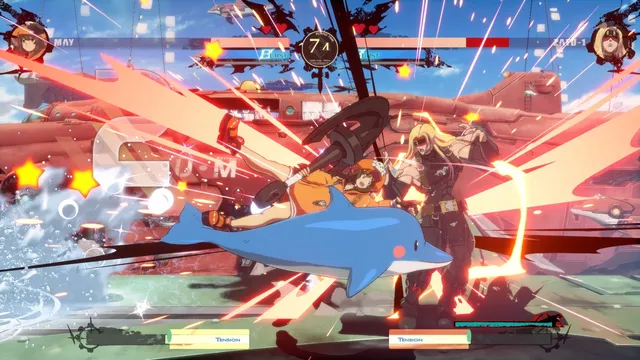
Let me get the obvious thing out of the way: Strive is staggeringly beautiful. Arc System Works’ hybrid 2D/3D art style has been refined across multiple games, and Strive is where it reached perfection. Every character looks like a hand-drawn anime frame, every move has specific frames of exaggeration that make the action readable from across a room.
But here’s what most “pretty fighting game” discourse misses: the visuals aren’t decoration. They’re information. Strive’s animation work is doing the same job as a UI element in any other competitive game — telling you what’s happening, what’s about to happen, and what your options are.
When Sol winds up for a Volcanic Viper, you can see it in the first frames. When Potemkin starts a Buster command grab, the animation telegraphs range and timing. Every super has a distinct startup flash that gives you just enough frames to react if you’re watching for it.
This is the fighting game equivalent of clear ability telegraphs in an arena brawler. The game is beautiful because readability is beautiful. Good competitive design and good visual design aren’t separate goals — they’re the same goal, expressed differently.
The Roman Cancel System Is Genius
If Strive’s visuals are the hook, the Roman Cancel system is the depth.
Roman Cancels let you spend meter (earned through combat) to cancel the recovery frames of any move. In practice, this means that every button in the game has hidden extensions. A blocked punch that would normally leave you vulnerable becomes a mix-up starter. A combo that would drop becomes an extended sequence. A defensive move becomes an offensive one.

There are four types of Roman Cancel — Red, Yellow, Blue, and Purple — each triggered by different states (attacking, blocking, neutral, or recovery). Each has different properties. Learning when and how to use them is its own game within the game.
What makes this brilliant is that it scales with the player. A beginner can use Red RC to extend a combo they’d otherwise drop. An intermediate player learns to use Yellow RC defensively to escape pressure. A high-level player uses all four types fluidly, reading situations and making meter decisions in fractions of a second.
This is the kind of system depth that keeps people playing fighting games for years. You’re never done learning. Every match reveals new possibilities.
Accessibility Without Dumbing Down
Strive caught flak from the legacy Guilty Gear community at launch for being “simplified.” Some of the long-combo, high-execution elements from Xrd were streamlined. Gatling routes were reduced. Air combos were shortened.
The criticism missed the point. Strive shifted complexity from execution (doing the combo) to decision-making (choosing what to do). The combos are shorter, but the neutral game — the spacing, the risk/reward of each approach option, the Roman Cancel decision tree — is deeper than ever.

The result is a game where a new player can pick up a character and do meaningful things within their first session, while a veteran is still discovering new setups after 500 hours. That’s the ideal curve for any competitive game — low barrier to entry, practically infinite ceiling.
Street Fighter 6 gets credit for Modern Controls (and rightly so), but Strive solved the accessibility problem first, and it solved it at a design level rather than an input level. The difference matters. Modern Controls in SF6 let you execute the same moves more easily. Strive’s approach made the moment-to-moment decisions more interesting while keeping the physical execution achievable.
The Rollback Netcode Matters
It should not be noteworthy in 2026 that a fighting game has good netcode. And yet.
Strive launched with GGPO-based rollback netcode, and it runs beautifully. Cross-continent matches that would be unplayable in delay-based games feel smooth at 3-4 frames of rollback. For a genre that lives and dies on frame-precise input timing, this is not a luxury — it’s a requirement.
The fighting game community spent years begging for rollback. Strive was one of the first major Japanese fighters to ship with it, and the difference in online player count between Strive and its delay-based predecessors tells the whole story. Good netcode isn’t just a feature. It’s what determines whether your online competitive scene exists at all.
Why It Matters for PVP
Guilty Gear Strive matters beyond the FGC because it proves something that applies to all competitive PVP games: you can make a deep competitive game accessible without sacrificing what makes it competitive.
The arena brawler genre faces the same tension. Bloodline Champions and Battlerite were deep, skill-expressive games that struggled with new player retention because the floor was too high. The lesson from Strive isn’t “make it easier.” It’s “make the early experience rewarding while keeping the ceiling high.”
Every decision in Strive can be understood by a new player watching over someone’s shoulder. That’s not because the game is simple. It’s because the game communicates itself clearly. The visuals, the sound design, the camera work — all of it serves the goal of making the game readable even when it’s running at 200 decisions per minute.
That’s the standard every competitive PVP game should aspire to.


Discussion