
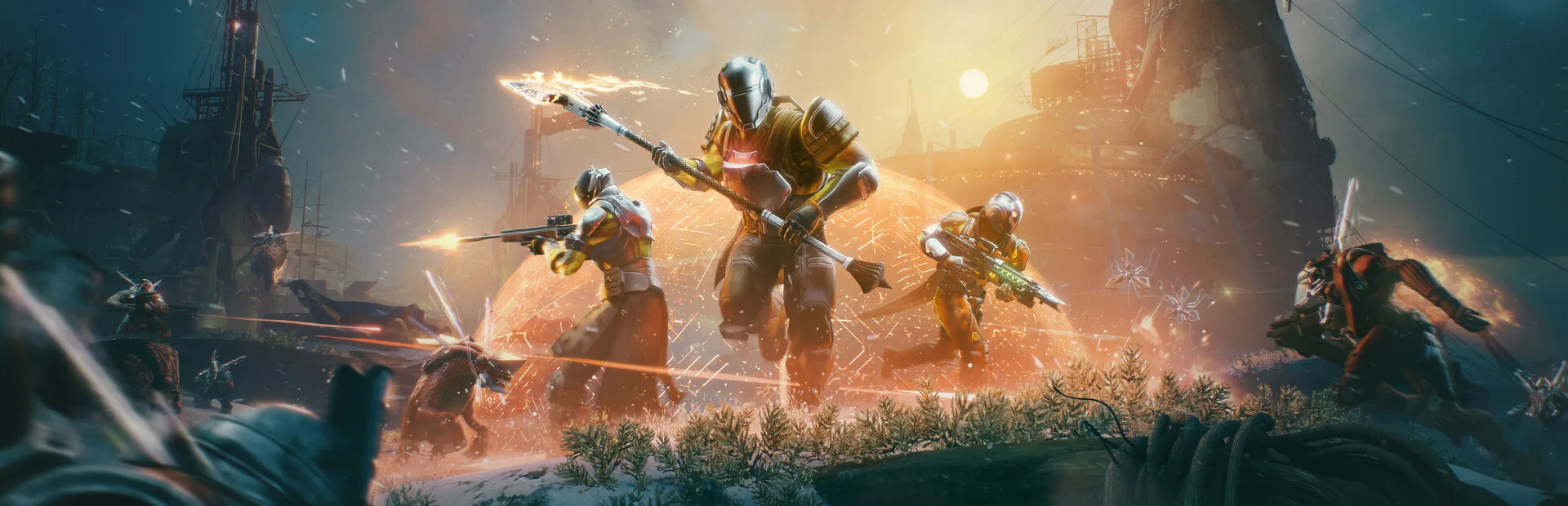
I hit a guy with a perfectly paced three-tap from a 140 hand cannon at 38 meters while strafing behind a pillar on Javelin-4 last week. Three headshots, bloom reset between each one, he went from full health to dead in under a second. The aim assist helped — it always does in Destiny — but the pacing was mine. The strafe timing was mine. The peek angle was mine. And in that 0.87 seconds of engagement, nothing in any other shooter on the market felt as good as that kill did.
Then I got shoulder-charged by a Titan skating at mach 3 from around a corner and died before my character model finished the kill animation. Welcome to Crucible. The highest highs and the most infuriating lows in competitive FPS, often within the same life.
This is the paradox that has defined Destiny 2’s PVP for its entire lifespan. The gunplay is unmatched. The sandbox support is nonexistent. And somehow, people keep playing.

The Gunplay Nobody Has Matched
I need to be specific about what makes Destiny’s gunplay different, because “good gunplay” gets thrown around so loosely that it’s lost meaning. Every marketing team in the industry says their game has great gunplay. Most of them are wrong.
What Bungie does that nobody else has replicated is the complete feedback loop on every trigger pull. It’s not one thing. It’s the combination: the weapon kick animation that gives each archetype a distinct rhythm, the aim assist cone that makes snapping to a target feel authoritative without feeling automated, the flinch system that creates genuine tension in duels, the hit sound that changes pitch based on precision versus body, and the way each weapon frame has a mathematically distinct optimal engagement distance that you feel before you learn. A 140 hand cannon plays differently from a 120. A rapid-fire pulse plays differently from a high-impact. Not just in TTK numbers on a spreadsheet — in the actual physical sensation of using them.
This is the product of two decades of institutional knowledge dating back to Combat Evolved. Bungie has spent longer tuning how a gun feels in your hands than most studios have existed. And it shows. When people quit Destiny and try other shooters, the most common complaint isn’t about content or systems or matchmaking. It’s that the guns don’t feel right. Apex has better movement. CS2 has better competitive integrity. Valorant has better tactical depth. None of them feel as satisfying on a per-shot basis as Destiny 2.
The weapon variety compounds this. Destiny’s sandbox has 40+ weapon archetypes across kinetic, energy, and heavy slots — and within each category, multiple frames with different fire rates and damage profiles. A 140 hand cannon player and a rapid-fire pulse player are learning fundamentally different games, and the skill ceiling on mastering any individual weapon type is enormous.
Why Bungie Doesn’t Care (Or Acts Like It)
Here’s where the praise stops and the frustration starts. Bungie has never treated Crucible like a product worth investing in. Not really. Not in the way that would make it competitive with dedicated PVP titles.
The map pool has been a running joke for years. Destiny 2 launched in 2017 with a set of Crucible maps, removed a bunch of them during the content vault era, slowly trickled some back, and has added a pitifully small number of new maps relative to the game’s lifespan. For context — a game that’s been live for nearly nine years has a map rotation that would embarrass a hero shooter in year two. Players have been grinding the same handful of lanes for so long that every sight line is burned into muscle memory, and not in the satisfying “deep knowledge” way. In the “I’m bored” way.
Sandbox balancing comes in waves that are too slow and too blunt. When something is broken in Crucible — and something is always broken — it stays broken for months. Entire seasons have been defined by a single dominant loadout because Bungie balances around PVE first and PVP second, always. The Wormhusk Crown era, the Recluse/Mountaintop era, the Stasis freeze tag era, Lorentz Driver pre-nerf, Strand grapple at launch — every veteran PVP player can name the weapon or subclass that ruined their experience for an entire season while Bungie’s sandbox team was focused on raid damage tuning.
The ability creep has been the slow poison. Destiny was originally marketed as a game where gunplay mattered, where your weapon skill was the primary differentiator in PVP. Over the years, subclass 3.0 reworks have dramatically increased ability uptime, and the result is a Crucible where a significant portion of kills come from abilities rather than guns. Shoulder charges, fusion grenades, Arc buddy turrets, Strand suspensions, Stasis slows — the game has accumulated so many “press button, get kill” mechanics that the gunplay Bungie perfected sometimes feels like a sideshow to the ability spam.
This is the opposite of what makes cooldown trading interesting in competitive games. In Battlerite or even Overwatch, abilities have long enough cooldowns that using them creates real vulnerability windows. In Destiny 2, ability cooldowns have gotten short enough — especially with exotic armor and stat builds — that there’s often no window to exploit. Your opponent threw a skip grenade and missed? Another one’s coming in eight seconds. That’s not a resource to track. That’s just noise.

Trials of Osiris: So Close, So Far
Trials is the closest Destiny 2 has to a real competitive PVP mode, and the history of Trials is a microcosm of Bungie’s entire PVP philosophy: launch it, neglect it, panic-fix it when the population craters, neglect it again.
Bungie replaced the original Trials of the Nine with Trials of Osiris in 2020, and for the first few weeks, it was electric. 3v3 elimination, win seven without losing, reach the Lighthouse for exclusive loot. The stakes were real, the format rewarded consistency, and the loot was aspirational enough to get people grinding.
Then the population collapsed. A flawless-gated loot system incentivizes gatekeeping. The best players farm cards early when average players are attempting runs. Average players get stomped, quit, and the pool gets sweatier. More average players quit. Sweatier still. Bungie has band-aided this with freelance queue, flawless pool, passage tweaks — but never solved it, because the core design creates a predator-prey dynamic between the top and middle of the skill curve.
The matchmaking debate in Destiny is a war that’s been raging for years. SBMM versus CBMM is genuinely one of the most divisive topics in the community. Bungie has tried both, has tried hybrid approaches, and has satisfied nobody. The fundamental issue is that Destiny’s netcode and peer-to-peer legacy infrastructure cannot support tight SBMM without introducing latency that makes the gunplay feel terrible. So you’re choosing between fair matches that feel laggy and unfair matches that feel crisp. Neither option is good. Both are a consequence of Bungie building Destiny’s networking for PVE cooperative play and then trying to bolt competitive PVP onto it.
The Population Death Spiral
Destiny 2 PVP has a retention problem that compounds every other issue. Bungie doesn’t invest in Crucible, so casual and mid-skill players bleed out. The remaining population skews hardcore. New and returning players get stomped. They leave faster. The pool gets sweatier. It’s the exact same death spiral that has killed several competitive games on our best PVP games list — a shrinking player base that accelerates its own shrinkage.
The difference is that Destiny 2 has the gunplay to sustain a healthy PVP community if Bungie invested even a fraction of its PVE resources. When Bungie announces a new raid, it’s a cultural event with trailers and a race to world first. When Bungie adds a Crucible map, it’s a line item in a patch notes blog post. The messaging is clear: PVE is the product, PVP is the side dish.

What Keeps People Playing Anyway
Despite all of this, there are people who have played Crucible nearly every day for years. I’m one of them, at least in spurts, and I know exactly why: the duels.
A primary weapon duel in Destiny 2 — two players strafing, peeking, pacing their shots, managing flinch — is one of the best individual combat experiences in FPS. It’s a rhythm game crossed with a positioning puzzle. You’re trying to out-strafe your opponent so your aim assist tracks them while theirs slides off you. You’re timing your peek to land the opening shot and ducking back before they can answer. You’re choosing between a committed push when you’ve landed the first two crits and a disengage when you’ve whiffed the opener. The time-to-kill is long enough that decisions matter but short enough that mistakes are punishing.
This is what Bungie understands about gunplay better than anyone: the TTK sweet spot. Destiny’s optimal TTK sits in a range — roughly 0.7 to 1.0 seconds for most primaries — where both players in a duel have time to react, reposition, and outplay, but not so much time that fights become drawn-out attrition wars. It’s fast enough to reward the first shot but slow enough that the first shot doesn’t guarantee the kill. That window is where mechanical skill expression lives, and Bungie nails it better than any other PVP shooter.
The movement adds a layer too. Destiny’s movement isn’t Apex-level mechanical expression, but each class has a distinct mobility identity — Hunter dodge for aerial strafe plays, Titan skating for aggressive angles, Warlock icarus dash for repositioning. Knowing how to duel a skating Titan is fundamentally different from dueling an icarus Warlock, and that variety keeps individual fights feeling fresh even when the maps don’t.
What Bungie Owes Its PVP Players
I’m not asking Bungie to turn Destiny 2 into an esport. The game’s power fantasy, the RNG loot rolls, the exotic armor perks that warp the sandbox — these are features, not bugs. Destiny PVP isn’t supposed to be Counter-Strike. It’s supposed to be chaotic and buildcrafty and occasionally unfair in funny ways.
But “not an esport” doesn’t mean “not worth investing in.” Bungie has spent years leaning on the excuse that Destiny is a PVE-first game to justify chronic PVP underinvestment. That excuse doesn’t hold when millions of players engage with Crucible regularly. It doesn’t hold when Trials weekends still drive significant playtime numbers. It doesn’t hold when the community has been begging for new maps, dedicated servers, and sandbox attention for the better part of a decade.
What Destiny 2 PVP needs isn’t a revolution. It needs consistent, genuine investment: a map every season instead of every year, balance patches measured in weeks instead of months, a competitive mode with an actual ranking system that people trust, and a networking infrastructure that doesn’t make SBMM feel like you’re playing through soup.
Bungie built the best-feeling shooter on the market and then told PVP players to be grateful for scraps. The gunplay deserves better. The players who stuck around despite everything deserve better. And honestly, Bungie deserves to see what Crucible could be if they ever treated it like the product it should be, instead of the afterthought it’s always been.
The talent is there. The foundation is there. The best gunplay in the genre is right there. All it needs is someone at Bungie to actually care about it.


Discussion