
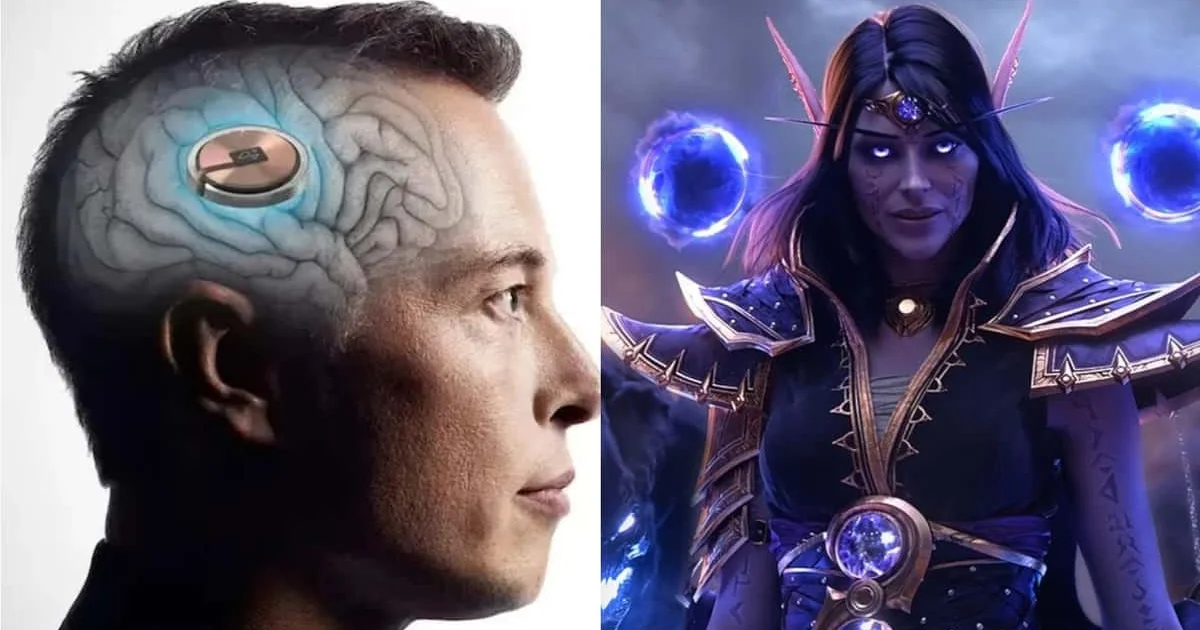
A British Army veteran who hasn’t moved his arms or legs since 2003 is now raiding World of Warcraft at full speed — using nothing but his brain. No mouse. No keyboard. No adaptive controller. Pure thought.
Jon L. Noble, a former paratrooper paralyzed from the shoulders down after a driving accident over two decades ago, received Neuralink’s N1 brain-computer interface implant in London this past December. One hundred days later, he’s exploring Azeroth, switching spells, and clearing raids without touching a single input device.
This isn’t a tech demo. This isn’t a curated three-minute clip. This is a man playing an MMO — the most input-heavy genre in gaming — with his mind.
From Day Zero to Thought-Controlled Raiding
The timeline of Noble’s progress reads like something out of science fiction, and he’ll be the first to tell you that’s exactly what it feels like.
Day 0 — Surgery under general anesthesia. Noble describes the procedure as “surprisingly easy.” A surgical robot threads ultra-thin electrodes into the brain through a small incision. The N1 chip sits flush with the skull, invisible from the outside.
Week 3 — Cursor control on a MacBook becomes second nature. “Scrolling, clicking, typing — all mind-controlled,” Noble reports. The brain adapts faster than anyone expected.
Day 80 — Noble fires up World of Warcraft for the first time with pure thought control. The first raid feels clunky. Then something clicks.
“Once my brain and the BCI synced, it was pure magic,” Noble says. “I’m now raiding, and exploring Azeroth hands-free at full speed — no mouse, no keyboard, just intention.”
By day 100, he’s moving seamlessly through gameplay — attacking enemies, switching between weapons and spells, navigating the world without delay. The chip translates neural signals into digital commands in real time: think “move forward” and your character walks. Think “cast spell” and the ability fires.
”It Gave Me a New Way to Live”
Noble hasn’t held back on describing what the implant means to him. The words he uses — “science fiction… magic… brilliant… addictive… overwhelming and incredibly motivating” — paint a picture of someone who’s been given something back that they thought was gone forever.
“100 days in and I already can’t imagine life without it,” he wrote. “The N1 didn’t just give me a new way to use a computer — it gave me a new way to live.”
The word that comes up most often: addictive. Not in the warning-label sense. In the sense that once you’ve controlled a machine with your thoughts, going back isn’t something you consider. “The freedom is addictive,” Noble says simply.
For someone who spent over twenty years without the ability to independently interact with a screen, “addictive” is probably the most understated compliment he could give.
Why World of Warcraft Matters Here
This isn’t an arbitrary game choice, and that’s important. Playing chess with Neuralink — as first patient Noland Arbaugh demonstrated — is impressive. Chess is turn-based, input-light, forgiving of latency. Playing WoW is a fundamentally different challenge.
World of Warcraft demands:
- Continuous movement across 3D space with real-time camera control
- Hotbar management — switching between dozens of abilities on short cooldowns
- Raid coordination — reacting to boss mechanics, positioning, and callouts in real time
- Multi-input parallelism — moving, casting, targeting, and communicating simultaneously
This is not “can the chip click a button.” This is “can the chip replace a keyboard, mouse, and the split-second reaction time required to not die in a Mythic dungeon.” And apparently, the answer is yes.
Arbaugh, Neuralink’s first human patient, hinted at this potential when he said the implant functioned like an “aimbot” and would particularly benefit fast-paced shooters. Noble has now proven that the technology works for one of the most mechanically complex genres in gaming.
What This Means for Gaming Accessibility
The gaming industry has made significant strides in accessibility — adaptive controllers, one-handed modes, configurable inputs. Those are important and should continue. But they all still require some physical input. You still need to be able to move something.
Neuralink’s brain-computer interface removes that requirement entirely.
For the estimated 5.4 million Americans living with paralysis — and millions more worldwide — this technology represents a path to full, independent gaming that no controller redesign could ever provide. Not adapted gaming. Not assisted gaming. The same gaming everyone else experiences.
Noble isn’t playing a simplified version of WoW. He isn’t using a special accessibility mode. He’s in the same Azeroth as every other player, on the same servers, doing the same content. The only difference is that his input device is inside his skull.
The Bigger Picture
Two patients. Two very different demonstrations. Arbaugh showed that a quadriplegic could play chess and browse the internet. Noble has shown that the technology scales to complex, real-time, input-heavy applications.
The N1 chip is still in clinical trials. It’s not something you can buy. The surgical procedure, while Noble describes it as straightforward, involves a robot threading electrodes into brain tissue. There are legitimate questions about long-term durability, safety at scale, and the ethical implications of commercial brain-computer interfaces.
But right now, today, a man who couldn’t move his arms for twenty-three years just cleared a raid in World of Warcraft by thinking about it. And he says he’s never going back.
“The freedom is addictive.”
That’s not a tech company’s marketing copy. That’s a paralyzed veteran describing what it feels like to play a video game for the first time in two decades. And if that doesn’t hit you somewhere, you might want to check your own wiring.
Discussion